
We are now in possession of all the pieces of our cosmological puzzle. As we reasoned in the Chapter Definition of Foundational Theories a fundamenta theory needs three pillars: what fundamentally exists (ontology), what is typical (measure) and what then inevitably emerges (the structure).
More essential than stating what we assume is what we don’t assume.
We do not assume finiteness.
If reality were fundamentally finite, one could immediately ask: finite by how much? Why n bits rather than n+1? What principle fixed that particular bound?
Any fixed finite limit appears contingent and therefore calls for a deeper explanatory layer.
For this reason, we do not posit a fundamentally finite substrate.
We also do not assume information as primitive.
Information presupposes distinguishability. At its simplest, this reduces to binary distinction: a bit, a difference between alternatives.
But declaring reality to be fundamentally informational or digital is itself a substantive ontological commitment.
A discrete ontology is conceivable, but so is a continuous one. Nothing prior licenses choosing one baseline over the other.
Therefore, we refrain from assuming that reality is fundamentally digital, continuous, informational, geometric, mathematical, or law-governed.
Therefore, we do not presuppose that reality is fundamentally discrete, informational, mathematical, or governed by prior, external laws.
We denote this unrestricted, pre-interpretive totality (U). We do not claim to know what it is.
Only that no specific formatting principle is granted ontological privilege a priori.
Despite radical agnosticism about the substrate, one empirical fact remains unavoidable: observer exists. Conscious, structured experience exists.
Based on all observational evidence, we as human beings possess a strictly finite informational structure.
As derived in the Chapter The Interpretation Problem information is not an inherent property of objective reality, but an emergent artifact of observation.
The “bit” is not the fundamental building block of the cosmos; it is the fundamental unit of distinction employed by a finite interpreter.
As derived in the Chapter Humans as Axiomatic Systems the universe is static. Under this view, every possible experience accessible to an observer must already be encoded within the total observer structure.
An intuitive analog is a guitar string.
The string itself is perfectly continuous. It isn’t made of discrete "tone particles."
Discreteness resonant modes emerge from the boundary conditions: when you pluck it, it can only vibrate at discrete, quantized frequencies (the fundamental note, the octave, the third harmonic, etc.),
This is because the string is clamped at both ends! The boundaries force a continuous medium to manifest discrete states.
Likewise, a finite observer interacting with an unrestricted reality may induce discrete informational structure without discreteness being ontologically primitive.
Under algorithmic or Solomonoff-style measures, low-complexity, highly compressible structures dominate typicality.
Finite observers would therefore be expected to find themselves embedded within stable, structured, compressible equivalence classes.
This motivates the minimal ontological assumption:
The first step remains unexplained. That is an explicit boundary of the theory.
We do not know what the unrestricted totality is.
We assume only that finite observers exist within it.
For formal descriptive purposes, we introduce a finite, static configuration space:

where each c ∈𝒞 is a complete, static snapshot of bits.
Each configuration c admits multiple potential descriptions d ∈𝒟(c). We quantify the total complexity Ctotal(d) of a description by splitting it into its dual spectral and geometric representations, matching our informational Lagrangian:

The spectral complexity Cs(d) measures the algorithmic bit-cost required to instantiate and track the wave-like modes:
![∑ [ ( ω ) ]
Cs(d) = Cost(Ai)+ Cost(ϕi)+ --i-
i Δ ω](ghghnd96x.svg)
where the sum runs over active spectral modes, Cost(Ai) represents the bit-depth of the amplitude envelope, Cost(ϕi) is the fixed-width register encoding the periodic phase interval [0,2π], and ωi∕Δω represents the linear resource allocation required to track the mode frequency relative to the minimum resolution threshold Δω.
The geometric complexity term Cg(d) accounts for the algorithmic overhead of localized spatial structures, boundaries, and metric fields. Consistent with our physical foundations, the spectral cost scales linearly with the number of active modes multiplied by their frequency, ensuring an exact algorithmic analogue to thermodynamic energy.
We have established that the quantum mechanical wavefunction compresses the possibility space of our universe through a spectral language (Cs), while General Relativity compresses its realization space through a geometric language (Cg).
Because the relationship between these two frameworks is a many-to-many mapping, any given observer wavefunction can be interpreted through nearly infinitely many different geometric spacetime metrics, and conversely, any spacetime manifold can be decomposed into nearly infinitely many different wavefunctions. This creates an unimaginably massive configuration space.
How does nature choose our specific reality from this vast haystack?
In information theory, when a system must be simultaneously validated across two dual representations, its joint probability is the product of its individual probabilities. Therefore, the absolute measure of any emergent physical state (s) within the totality is given by the Joint Compressibility Equation:
| (32.1) |
This deceptively simple formula yields a profound variational principle for a unified framework. Nature minimizes the total description length. The cosmos is governed by a singular, overarching informational Lagrangian:
| (32.2) |
Neither geometry nor waves are primary; they are equal, co-dependent projections of a single underlying informational matrix. Our observed reality is the exact mathematical sweet spot of this joint optimization. Spacetime is smooth and the quantum world is lawful because this specific configuration represents the absolute shortest combined code nature can write.
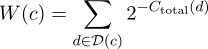
The raw algorithmic weight of a static configuration c is accumulated across all its valid descriptions:
This defines our raw baseline probability distribution over the state space:
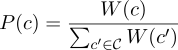
Because Cs(d) maps complexity linearly to frequency, the calculation 2−Ctotal(d) inside the summation guarantees that high-frequency states suffer genuine exponential probability suppression, mirroring the Boltzmann distribution (P ∝ e−βE) found in statistical mechanics.
An observer is modeled as a grading semantic functional:
![μO : 𝒞 → [0,1]](ghghnd101x.svg)
which measures how strongly a given bit configuration realizes a stable, observer-relative structure. This functional induces an observer-relative equivalence relation c1 ∼Oc2 whenever c1 and c2 realize the same relational observer structure to within the tolerances encoded by μO.
The observer-conditioned probability then becomes:

To transition from the probability of a single static configuration P(c∣O) to the probability of an entire experienced history, we must track how an observer traverses the configuration space. Let a path γ ∈ ΓO represent a sequence of configurations ordered by our internal temporal relation ≺O. Because the configurations along the path are independent slices of the static totality, the total probability of the path is the product of its individual constituent measures, meaning their algorithmic costs sum additively.
By changing our informational units from bits to natural units (where 2−C = e−C ln 2), we can express the global probability of an entire observed history γ:
![ℙ (γ | O ) =-1-exp (− λ𝒞O [γ ]), γ ∈ Γ O
ZO](ghghnd103x.svg)
where 𝒞O[γ] = ∫ γCtotal(c)dt represents the accumulated informational cost along the path, and λ acts as an algorithmic inverse temperature (scaling the bit-to-nat conversion and the observer’s filtering acuity). This states that observed physical laws are simply the large-deviation minimizers of the total informational cost function 𝒞O[γ] over the set of all semantic paths.
Our core hypothesis is that configurations capable of supporting observers strongly favor smooth, low-frequency spectral content. Sharp, chaotic particle trajectories require massive high-frequency modes, which exponentially spike the linear description length Cs(d) and are instantly suppressed by the joint measure.
As a result, observer-compatible realities are overwhelmingly dominated by configurations exhibiting inertia, smooth curved paths, and law-like behavior. Spacetime geometry emerges precisely because it makes macroscopic informational boundaries computationally cheap to describe (Cg).
Time in this static block-universe is not a fundamental background dimension. It emerges entirely as an internal ordering relation ≺O on configurations, where c1 ≺Oc2 if c2 supports a more advanced, stable realization of the observer functional μO. The experienced flow of time corresponds to traversal along the most compressible, optimized paths through this timeless superposition.
We have three emergent layers of reality:

Discrete reality (particles) are localized, high-density “knots” where the smooth continuous wave-codec (ψ) meets the finite digital register of the observer. The global physics remains governed entirely by our dual informational Lagrangian:
| (32.3) |
The discrete data (D) is the emergent output of this joint minimization when parsed by a bounded interpreter. Spacetime is smooth (G), fields are continuous (ψ), yet our observations are invariably quantized into discrete particless (D).
The fourth requirement for any foundational theory is a distinctive name that captures the deepest essence of the framework.
We have developed a theory featuring:
This may be summarized as an observer-first ontology embedded within a static, abstract informational totality.
This gives us:

or simply

for
Informational Abstract Measure — exponentiated over everything.
Iameverything
![1
ℙ(γ | O) =---exp (− λ 𝒞O[γ]) , γ ∈ Γ O
ZO](ghghnd108x.svg)



