
Suppose we possessed a complete physical description of the universe: the exact information for every particle state, every quantum amplitude, and the full spacetime metric.
What is this information fundamentally? In a binary framework, we would call it a bitstring—a raw sequence of bits.
This introduces a massive problem: a raw informational structure does not announce what it represents. The exact same finite set of bits can be interpreted as a number, a computation, an entire universe, random noise, or nothing at all.
Consider Alice using a decimal system, motivated by biological convenience (ten fingers):
Bob, working in a computational environment, adopts binary representation:
In binary arithmetic the same relation becomes:

If Alice encountered Bob’s notation without context, she would misinterpret the symbols. In particular, 102 does not refer to ten. Even the full expression requires an assumed encoding scheme. Thus, meaning is not intrinsic to the symbol structure alone, but depends on an interpretive convention.
The arbitrariness of representation becomes clearer when we replace the digits entirely. The binary alphabet {0,1} may be replaced with coin faces {H,T}:

Operational symbols such as + and − are likewise part of a chosen syntactic convention, not intrinsic to the underlying relation.
In finite digital systems, identical bit patterns admit multiple semantic interpretations. For an 8-bit word:
The physical state is identical; only the interpretation differs.
Even ordering conventions are not intrinsic. A bitstring such as 001 may correspond to different values depending on bit significance:
These are merely two of the n! possible permutations of bit significance.
Consider a computer in full physical detail. A memory dump yields only a finite sequence of bits. The CPU, instruction set, and storage devices are themselves physically instantiated information structures. At the level of raw physical state there is no intrinsic separation between “code” and “data”. This distinction arises solely through an interpretive layer.
The global state of an n-bit system occupies a configuration space of size 2n. Computation, or any other semantics, arises only from relations between states under a chosen interpretive rule.
A raw bitstring does not intrinsically contain logic, syntax, semantics, truth conditions, or consistency relations. These arise only after selecting an interpretive scheme.
As the number of bits increases, the space of possible interpretations grows combinatorially. A single finite configuration admits a vast number of syntactically valid decompositions into code/data partitions, memory layouts, instruction interpretations, and execution histories.
While the state space itself contains only 2n configurations, the number of possible transition functions is (2n)2n . For n = 3 bits this is already 88 = 16777216. For n = 10 the number has thousands of digits.
This vast explosion of possible interpretive rules implies that neither a “Universe” nor a “Computer” can be regarded as fundamental in isolation — the interpretive rule space grows enormously faster than state space.

Even after an interpretation is assigned, it is not unique. Different interpretive schemes may preserve the same underlying relational structure.
Physics has long grappled with this exact representational ambiguity, demonstrating that distinct mathematical formulations can map to identical physical realities.
In mathematical physics, when a physical state remains unchanged under a change of local descriptive frameworks, we call that symmetry a gauge invariance.
Consider a sufficiently large bitstring. Under one interpretation it may appear as random noise. Under another it may be interpreted as implementing the relation 2 + 3 = 5, as encoding a mathematical structure, or even as the informational substrate of an observer. Instruction layouts, memory partitions, addressing schemes, and representational conventions may all vary, yet certain structural relations can remain invariant across these transformations.
We therefore define:
Interpretive Equivalence Class
Two interpretations belong to the same interpretive equivalence class if they preserve the same observable relational structure under admissible transformations.
What ultimately matters is not the precise arrangement of symbols, but the invariant relational structure that survives reinterpretation:

This relational structure is more primitive than computation, mathematics, or any particular semantics. All of these are merely possible interpretations.
For example, when humans interpret the output of a computer monitor, they rely on an astronomical stack of shared conventions (encoding standards, pixel geometry, scan order, handedness, row length, etc.). Changing these conventions can render the identical underlying data unrecognizable or meaningless.
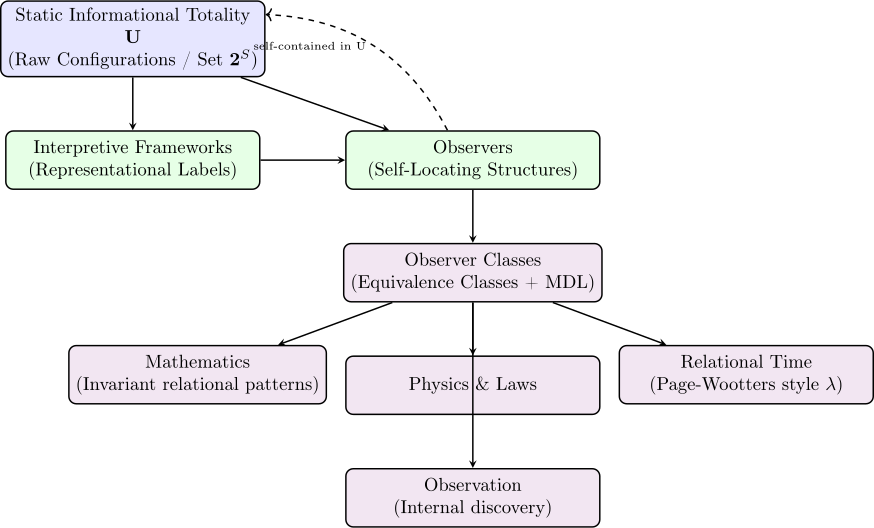
By synthesizing the semantic nakedness of raw data with the mathematical necessity of gauge invariance, we arrive at the foundational thesis of this framework:
Principle 31.5.1: Self-Interpretive Information Principle (SIIP)
The raw informational substrate is semantically silent.
Within this silent substrate exists a vast landscape of possible interpretive frameworks, equivalence classes, and self-locating observers.
Instead of asking ’Why does this specific universe exist?’, a self-locating observer asks: ’Given that all possible configurations exist, which specific slice of them am I currently observing?
The preceding analysis allows us to revisit and resolve Eugene Wigner’s famous puzzle concerning the "unreasonable effectiveness of mathematics in the natural sciences."
Its effectiveness is an emergent consequence of data compression.
Maximum compressibility yields maximum probability, which in turn provides maximum predictability. The "laws of physics" are simply regularities emerging from maximal compression.
To exist as stable, conscious entities, we must minimize our internal description length to maximize our probability of existence.
The most efficient way for nature to build complex observers is to construct them out of the exact same informational sub-structures.
Common sub-structures compress best. We are all made of the same fundamental building blocks because those specific blocks minimize total description length.
Consequently, mathematics is unreasonably effective because the interpreters themselves are highly unified.
This perspective dissolves Wigner’s paradox. The universe does not need to be inherently mathematical; it only needs to be rich enough in raw information to allow compressed structures to form.
Mathematics works so well because we are highly unified filters.
Mathematics is not fundamental.