 bits of
information. The total number of possible raw configurations is already
bits of
information. The total number of possible raw configurations is already  . For
. For  —a tiny
system by physical standards—this yields approximately
—a tiny
system by physical standards—this yields approximately  possible states. Even listing them all
would be impossible on any conceivable computer.
possible states. Even listing them all
would be impossible on any conceivable computer.
The ultimate test of the Iameframework developed so far is whether it can generate something that resembles observed reality using only its own principles.
We constructed a minimal proof-of-concept simulation with one central question:
Given only an observer-conditioned spectral compression measure, can anything resembling inertia, interference, or mutual attraction emerge — without being explicitly programmed?
No forces, equations of motion, spacetime metric, or physical laws were hard-coded. The system is a pure informational engine that selects configurations solely according to a joint spectral-geometric complexity measure.
While the framework presented in this book offers a unified informational picture of reality, demonstrating it through direct computational proof-of-concept faces severe practical obstacles.
The core difficulty is combinatorial explosion. Consider a modest system containing only bits of
information. The total number of possible raw configurations is already . For —a tiny
system by physical standards—this yields approximately possible states. Even listing them all
would be impossible on any conceivable computer.
The problem grows dramatically worse when we consider dynamics. The number of possible ways to order
or traverse these configurations is  , a number so enormous that it dwarfs even the most extreme
quantities in cosmology. For comparison, the number of atoms in the observable universe is
roughly
, a number so enormous that it dwarfs even the most extreme
quantities in cosmology. For comparison, the number of atoms in the observable universe is
roughly  ;
;  is inconceivably larger. This is super-exponential growth, rendering
brute-force enumeration or simulation fundamentally intractable even for laughably small
systems.
is inconceivably larger. This is super-exponential growth, rendering
brute-force enumeration or simulation fundamentally intractable even for laughably small
systems.
Yet these figures only describe the raw configuration space.
The true complexity lies in the interpretation space—the vast set of possible semantic mappings that can
be applied to the same binary data. Pure bits carry no inherent meaning, ontology, or physical
interpretation. A given string of 0s and 1s can, in principle, be decoded as a wavefunction, a spacetime
geometry, a conscious observer, or sheer noise, depending on the chosen descriptive language. The number
of reasonable (and unreasonable) interpretive schemes is itself effectively unbounded. Each interpretation
then carries its own spectral complexity  and geometric complexity
  , which must be evaluated
under the joint compressibility measure.
, which must be evaluated
under the joint compressibility measure.
This creates a double-layered explosion: an astronomical space of raw configurations, multiplied by an even larger space of valid descriptions and observer functionals.
Direct simulation of the full framework is therefore not merely difficult—it is computationally impossible with any realistic resources, now or in the foreseeable future.
Fortunately, brute-force enumeration is not the only path forward. Just as we do not need to simulate every possible fluid molecule to understand aerodynamics, we can seek clever approximations, analytical limits, observer-centric selection principles, and targeted numerical experiments on small but representative subsystems.
For the above mentioned reasons, and since any full biological observers are computationally intractable, we use a simplified proxy: a localized Gaussian wave packet with limited internal memory — essentially a small, coherent “Gaussian blob”. The size and memory capacity of this blob are adjustable parameters.
The simulation explores possible “observer walks” (sequences of configurations consistent with the persistence of this blob) and selects them according to the induced observer-conditioned measure P(c∣O).
A complex-valued wavefunction class is implemented, with method to compute spectral complexity from frequencies, amplitudes, and phases. Geometric complexity is approximated through a linearized measure of curvature and boundary sharpness.
A Metropolis-Hastings sampler explores the configuration space, guided exclusively by the minimization of total spectral-geometric description length.
To test whether the joint compressibility framework can produce realistic physics, we started with a minimal 2+1D simulation. The goal was simple: start with pure randomness and see whether anything resembling inertia, wave interference, or mutual attraction would emerge when configurations are selected solely based on how easily they can be compressed.
The simulation works as follows:
At its foundation is a random noise substrate — a sea of particles whose positions are continually redrawn from a probability distribution. This distribution is generated by the interference patterns of complex-valued wavefunctions, similar to how quantum mechanics describes reality.
Within this noisy environment, observers are modeled as localized Gaussian wave packets —
essentially smooth, coherent “blobs” of information. Each blob represents a simplified observer
with limited memory and internal structure. These observers do not follow pre-programmed
laws of motion. Instead, at every step, the system evaluates many possible small changes to
their trajectories and selects those that minimize the total spectral and geometric complexity
( ).
).
This implements the core principle of the framework: the more compressible an observer’s experience is, the more statistically likely it becomes. Smooth, predictable motion compresses far better than erratic, high-frequency jitter. As a result, the observer-blobs naturally develop inertia — they prefer to continue moving in gentle curves rather than making sudden turns, because sharp changes create expensive high-frequency components in the wavefunction.
Quantum-like behavior emerges directly from the complex-valued wavefunction representation. Interference patterns appear naturally, without being programmed.
Emergent mutual attraction (a primitive form of gravity) arises because overlapping wavefunctions between nearby observers create regions of higher probability density in the space between them. The observers are statistically “pulled” toward areas where more microscopic configurations support their persistence.
No forces, no equations of motion, and no spacetime metric were ever coded into the simulation. The only rule was: keep the observer’s description as short and compressible as possible.
The simulation is deliberately minimal. It uses a few thousand particles on a 2D grid and runs for a few hundred time steps. Even with these severe limitations, clear structured behavior consistently appears.
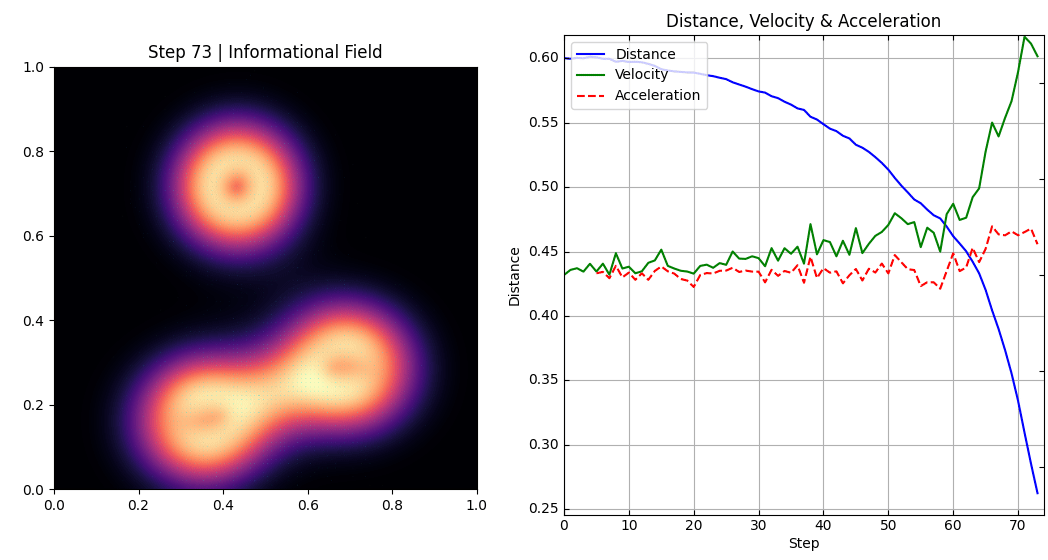
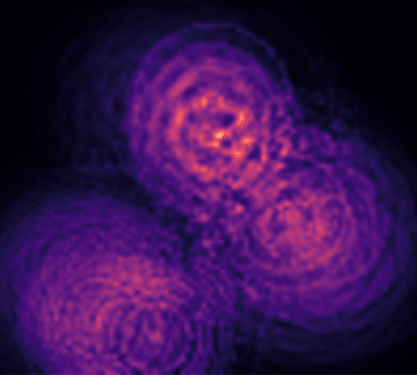
These results suggest that key aspects of classical and quantum behavior can arise purely from informational compression.
Despite these encouraging results, a significant limitation appears. The Gaussian blobs eventually lose their individual identities and merge into a single undifferentiated structure. There is no stable repulsion or exclusion principle at short distances.
In standard quantum mechanics, fermions obey the Pauli exclusion principle due to antisymmetry of the wavefunction. In our pure compression-based approach, symmetric (bosonic) configurations are strongly preferred because they allow shared spectral modes and lower total description length. Antisymmetric configurations appear significantly more expensive and are therefore suppressed.
Hard-coding antisymmetry would violate the spirit of the project. Finding a natural mechanism within the compression measure that makes multiple occupancy of the same state dramatically more costly for coherent observers remains the most important open challenge of the theory.
This proof-of-concept simulation demonstrates that important features of physical law — inertia, wave interference, and weak attraction — can emerge from pure spectral compression and observer conditioning, without being explicitly programmed.
It supports the broader thesis that law-like behavior is not imposed from outside but arises internally as a consequence of how self-interpretive information is most efficiently organized. However, the emergence of stable, distinguishable particles (fermionic statistics) is not yet achieved and constitutes the current frontier.
By applying an observer filter (the Gaussian blob) across all possible configurations and evaluating them under complex-valued Fourier compression (the wavefunction), smooth and symmetric trajectories consistently show the highest compressibility.
In the macroscopic case, fine interference is averaged over, and observers tend to converge. In the microscopic case, wave-like behavior becomes dominant.