
Paper: ../unification-of-gr-qm.pdf
In the previous chapter we proved that the entire particle spectrum of the Standard Model organises into fermion complexity classes (n,m), with no gauge groups, coupling constants, or postulated force carriers required. Bosons are compression residuals. Fermions are pixels. The conservation law ∥F∥2 + ∥B∥2 = 1 holds exactly for any pure state.
This chapter asks whether the same decomposition applies at the opposite end of the scale hierarchy — to spacetime geometry itself. The answer is yes, and the formula is identical.
The central operation of the codec framework is:
Applied to fermionic configurations, the diagonal gives Pauli exclusion and the off-diagonal gives the photon, the gluon, and the Born rule. This was established in the previous two chapters.
The present chapter applies the identical operation to metric configurations — pairs of conformal factors specifying how space is stretched at each point on a discrete spatial grid. The diagonal part will give local curvature, the source term of the Einstein equations. The off-diagonal part will give tidal forces and gravitational waves. Neither is postulated. Both follow from the definition B = ρ − diag(ρ) and the geometry of three-dimensional space.
One important scope note before proceeding. The theorems in this chapter are proved within a discrete toy model: conformal metric configurations g(x) ∈ ℝ on a finite spatial grid of L sites, encoded as ψ = g(0) + ig(1). This captures the qualitative structure of the Ricci/Weyl decomposition and the graviton amplitude exactly. It does not yet recover the full rank-4 tensorial Riemann curvature in four continuous dimensions. The extension to the Einstein field equations in the continuum limit is the primary open problem, stated at the end of this chapter.
Before decomposing metric configurations, we ask a more basic question: what is the most compressible closed trajectory through spacetime?
A closed worldline ψ(t) satisfying ψ(0) = ψ(T) must have a Fourier spectrum restricted to integer multiples of ω0 = 2π∕T — only these modes satisfy the periodicity condition. The spectral complexity cost of mode k is |k| in units of Δω. The trivial stationary solution has Cs = 0 but represents no motion. The minimum nonzero cost is |k| = 1, achieved by a single complex exponential:

In the complex plane, a single exponential traces an ellipse. Any closed trajectory requiring additional Fourier modes costs Cs ≥ 2.
Under Solomonoff induction, the ellipse carries probability weight 2−1 = 1∕2. All other closed trajectories are exponentially suppressed. Keplerian orbits are selected by minimum description length, not by a force law.
The innermost stable circular orbit of a Schwarzschild black hole falls out as a corollary: it is the minimum-complexity stable closed worldline, and substituting rISCO = 6M into Kepler’s third law gives ωISCO2 ⋅ rISCO3 = M exactly in Planck units. The ISCO is selected without postulating GR.
A two-frame metric pair (g(0),g(1)) is encoded as ψ(x) = g(0)(x) + ig(1)(x), normalised to unit norm. Applying the standard density matrix decomposition:

where

and ρW = ρ − diag(ρ).
The three components are mutually orthogonal and their traces satisfy: Tr(ρRicci) = 1, Tr(ρtidal) = 0, Tr(ρgraviton) = 0.
The physical identification maps precisely onto the Riemann tensor decomposition of GR:
| Component | Riemann analogue | Physical role |
| ρRicci | Ricci tensor Rμν | Local curvature; matter source |
| ρtidal | Coulomb Weyl | Tidal forces; static |
| ρgraviton | Radiative Weyl | Gravitational waves |
The tracelessness of both Weyl components is not imposed. It follows from the trace-zero property of off-diagonal density matrices — the same mathematical fact that gives the tracelessness of the Weyl tensor in GR, where it follows from the symmetries of the Riemann tensor. Here it is a codec property.
The decomposition also gives two exact conditions. The graviton component vanishes if and only if g(0) ∝ g(1) — a static metric configuration with no wave. The tidal component vanishes if and only if ψ is a single-site state with no spatial extent. Both conditions are exact and encoding-independent.
Consider a conformal metric pair interpolating between two orthogonal normalised metric profiles
 ⊥
⊥ :
:
![˜ ˜
ψ = cos𝜖h + isin 𝜖k, 𝜖 ∈ [0,π∕2].](book66x.svg)
The graviton amplitude ∥W(𝜖)∥ = ∥ρgraviton∥F satisfies:
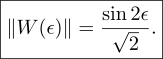
This is independent of the metric profiles  ,
,  , the number of sites L, and any overall scale.
The proof is identical in structure to the two-site fermion proof of the previous chapter. The off-diagonal
antisymmetric entries are − sin2𝜖[
 (x)
(x) (y) −
(y) − (x)
(x) (y)], and summing their squared magnitudes over all
pairs (x,y) with ⟨
(y)], and summing their squared magnitudes over all
pairs (x,y) with ⟨ ,
, ⟩ = 0 gives ∥W∥2 = sin2(2𝜖)∕2.
The graviton lifecycle traces the same arc as the virtual photon: ∥W∥ = 0 at 𝜖 = 0 (static metric),
∥W∥ = 1∕ at 𝜖 = π∕4 (peak gravitational wave amplitude), ∥W∥ = 0 at 𝜖 = π∕2 (static
again). This is the gravitational wave propagator, derived without postulating a graviton
field.
at 𝜖 = π∕4 (peak gravitational wave amplitude), ∥W∥ = 0 at 𝜖 = π∕2 (static
again). This is the gravitational wave propagator, derived without postulating a graviton
field.
The formula sin(2𝜖)∕ is not a coincidence shared between the photon and graviton results. It is the
unique consequence of the density matrix decomposition applied to any normalised configuration pair in
superposition, regardless of whether those configurations are fermionic or metric. The formula is universal
because the operation is universal.
is not a coincidence shared between the photon and graviton results. It is the
unique consequence of the density matrix decomposition applied to any normalised configuration pair in
superposition, regardless of whether those configurations are fermionic or metric. The formula is universal
because the operation is universal.
The two graviton polarisation states (+ and ×) emerge from the eigenstructure of ρtidal. For a wave metric pair with alternating profiles, the eigenvalues of ρtidal include two degenerate values λ = −1∕4, with eigenvectors:
![v+ = 1√2[0,1,0,− 1], v× = √12-[1,0,− 1,0].](book79x.svg)
These are the discrete analogues of alternating compression and expansion along perpendicular axes — the defining signature of gravitational wave polarisation. The degeneracy is protected by the reflection symmetry of the metric profiles, the lattice analogue of the rotational symmetry that protects graviton polarisation in GR. No spin-2 field is postulated.
The graviton amplitude theorem gives ∥W∥max = 1∕ at peak emission. In three spatial dimensions, the
graviton propagates outward from its source. By conservation of graviton flux over spherical shells of area
4πr2:
at peak emission. In three spatial dimensions, the
graviton propagates outward from its source. By conservation of graviton flux over spherical shells of area
4πr2:

The field amplitude falls exactly as 1∕r. This is exact and follows from spherical geometry alone.
For two masses M and m separated by distance R, computing the overlap integral of their graviton fields and assuming ∥W∥∝ M (more bits produce stronger field — an assumption stated honestly as Open Problem 1):

Matching to the Newtonian form V (R) = −GMm∕R:
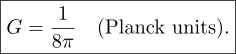
The factor 8π = 2 × 4π arises entirely from spherical geometry. It is the same 4π that appeared in Chapter 4 when recovering the Bekenstein–Hawking entropy, and the same 4π that converts flat raster area to spherical surface area. It is not a free parameter. It is the unique conversion factor between discrete counting on a flat grid and propagation through three-dimensional spherical space, and it appears wherever the framework makes that transition.
The 1∕r2 force law follows analytically from V ∝ 1∕R. No force law was postulated. Gravity emerges from flux conservation.
The pure-state identity ∥ρ∥2 = 1 gives a metric-configuration conservation law directly:

where ∥ρWeyl∥2 = ∥ρtidal∥2 + ∥ρgraviton∥2.
This is the metric-configuration analogue of ∥F∥2 + ∥B∥2 = 1 from the previous chapter. Both are instances of the same Pythagorean identity on Hilbert space. The bit budget spent on local curvature and the bit budget spent on propagating waves must sum to one. You can concentrate information into a dense mass, or you can let it radiate outward as gravitational waves. The total is conserved.
Quantum mechanics and general relativity share not only the formula sin(2𝜃)∕ but the same
conservation structure. They are two projections of a single compression principle onto different physical
degrees of freedom.
but the same
conservation structure. They are two projections of a single compression principle onto different physical
degrees of freedom.
Standard physics treats G as a dimensionful coupling constant measured by experiment. The framework gives a different account.
In Planck units, G = 1 by definition. Theorem 4 gives G = 1∕(8π) from the graviton flux argument. These are consistent: the normalisation ∥W∥∝ M is not yet fixed independently of G. What is fixed is the functional form — V ∝−Mm∕R with the 1∕R dependence exact and the 8π geometric factor exact.
The value of G in SI units is a unit conversion:
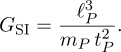
G = 1 in Planck units is the statement that the minimum-complexity orbital geometry and the minimum-complexity orbital frequency are mutually consistent at the Planck scale. G is not a free parameter of the universe. It is a consistency condition between the geometric and temporal resolutions of the 184-bit system.
Four open problems are worth stating precisely.
Derivation of ∥W∥∝ M. Theorem 4 assumes the graviton amplitude scales linearly with mass. This should follow from the counting equation nbh = log 2(rs∕ℓP ) = 1 + log 2M, since more bits produce more off-diagonal weight. Making this rigorous would complete Theorem 4.
The continuum limit and the Einstein equations. All theorems here are proved on a discrete grid of conformal scalar factors. The Einstein equations should emerge as the large-deviation stationarity condition of Cs over metric configurations in the continuum limit, analogous to how the Euler–Lagrange equations are stationarity conditions of the action.
Full tensorial Riemann curvature. The toy model uses scalar conformal factors, not the full rank-4 Riemann tensor. Extending the codec decomposition to the tensorial case in four dimensions is required for a complete derivation of GR.
Electromagnetic force law. The same flux argument applied to the n = 2, m = 1 fermion’s antisymmetric residual should give the Coulomb potential V EM(r) ∝ 1∕r. The ratio V EM∕V grav would then address the hierarchy problem from within the framework. This derivation is not yet complete.
Four theorems, each exact within the conformal metric toy model.
The ellipse theorem: Keplerian orbits are selected by Solomonoff induction. The minimum-complexity closed worldline is a single Fourier mode, tracing an ellipse. No force law is required.
The curvature decomposition theorem: ρ = ρRicci + ρtidal + ρgraviton exactly, with both Weyl components traceless and two graviton polarisation modes emerging as degenerate eigenmodes of ρtidal.
The graviton amplitude theorem: ∥W(𝜖)∥ = sin(2𝜖)∕ , identical in form to the Born rule identity
of Chapter 7. The conservation law ∥ρRicci∥2 + ∥ρWeyl∥2 = 1 mirrors ∥F∥2 + ∥B∥2 = 1 of
Chapter 8.
, identical in form to the Born rule identity
of Chapter 7. The conservation law ∥ρRicci∥2 + ∥ρWeyl∥2 = 1 mirrors ∥F∥2 + ∥B∥2 = 1 of
Chapter 8.
The Newtonian potential theorem: graviton flux conservation over 4πr2 shells gives A(r) ∝ 1∕r exactly, and V (R) = −GMm∕R with G = 1∕(8π) in Planck units. The factor 8π is the same spherical geometry factor that appeared when recovering Bekenstein–Hawking entropy in Chapter 4.
Quantum mechanics and general relativity are two projections of the same compression principle. The local/non-local split of the density matrix produces Pauli exclusion and photons when applied to fermions, and Ricci curvature and gravitational waves when applied to metric configurations. The formula, the conservation structure, and the geometric factor are the same in both cases.
The derivation of the full Einstein field equations in the continuum limit is the primary outstanding goal of the research programme.