
In the previous chapter we proved four exact results from the single definition B = ρ − diag(ρ): Pauli exclusion, the universal boson, the Born rule identity, and the virtual propagator lifecycle. All followed from the codec structure alone, with no interaction terms introduced.
This chapter extends the analysis. The previous results concerned a fermion hopping between two sites. The question now is: what happens when a fermion is delocalised across n sites? The answer will be three exact theorems about the norm structure of any fermion, a conservation law that subsumes all previous results, and a classification of the particle spectrum that requires no gauge symmetry groups, coupling constants, or postulated particle species.
Consider a fermion in equal superposition across n sites:
for arbitrary real phases ϕk. Split the density matrix ρ = |ψ⟩⟨ψ| into its diagonal and off-diagonal parts:

Three things are true about these objects, for any n and any choice of phases.
Universal Fermion Norm. ∥F∥ = 1∕ .
.
Proof. Fk = |ψk|2 = 1∕n for all k, so ∥F∥2 = ∑ k1∕n2 = 1∕n. □
Universal Boson Norm. ∥B∥ = 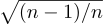 .
.
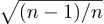
Proof. |ρij|2 = 1∕n2 for all i≠j. There are n(n−1) off-diagonal pairs, giving ∥B∥2 = n(n−1)∕n2 = (n−1)∕n. □
Conservation Law. ∥F∥2 + ∥B∥2 = 1.
Proof. For any pure state ρ2 = ρ, so ∥ρ∥2 = Tr(ρ2) = Tr(ρ) = 1. Since F and B occupy orthogonal subspaces, the result follows. □
All three results are phase-independent. They hold for any n ≥ 1 and any choice of ϕk. The conservation law subsumes the two-site result of the previous chapter: setting n = 2 and ψ(𝜃) = cos𝜃ei + isin𝜃ej recovers ∥F∥2 + ∥B∥2 = 1 as a special case.
The physical reading is direct. As a fermion delocalises across more sites, its fermionic content ∥F∥
decreases as 1∕ while its bosonic content ∥B∥ increases toward 1. The more spread out
the fermion, the richer its compression residual. The conservation law ensures these always
balance.
while its bosonic content ∥B∥ increases toward 1. The more spread out
the fermion, the richer its compression residual. The conservation law ensures these always
balance.
| n | ∥F∥ | ∥B∥ | ∥F∥2 | ∥B∥2 |
| 1 | 1 | 0 | 1 | 0 |
| 2 | 1∕ | 1∕ | 1∕2 | 1∕2 |
| 3 | 1∕ |  | 1∕3 | 2∕3 |
| 4 | 1∕2 |  ∕2 ∕2 | 1∕4 | 3∕4 |
The norms ∥F∥ and ∥B∥ depend only on n. The internal structure of the compression residual — its symmetry under transposition — depends on the phase pattern, specifically on the winding number m: the number of full phase rotations the pattern makes around the ring of n sites.
The natural minimum-complexity phase patterns on an n-site ring are the discrete Fourier modes ϕk(m) = 2πmk∕n, ordered by ascending spectral complexity. The symmetry of B under these patterns determines whether the fermion can exist as a free asymptotic state:
The pair (n,m) — sites and winding number — defines a fermion complexity class. This is the complete specification. No gauge groups, coupling constants, or symmetry postulates are required.
The two-site fermion has ∥F∥ = ∥B∥ = 1∕ — equal fermionic and bosonic content.
For winding m = 1, the compression residual B is purely antisymmetric, with eigenvalues ±1∕2 and the universal −π∕2 phase of the previous chapter. The fermion has a self-contained antisymmetric residual and propagates freely. This is the charged lepton — electron, muon, or tau, depending on the complexity level.
What Standard Model language calls a photon is the name given to the correlation between two such fermion events. When one charged lepton recoils, another does so in a correlated way. The codec encodes this correlation in the off-diagonal of ρ. No separate photon particle is required.
For winding m = 0, the residual B is purely symmetric, with zero net phase winding. The fermion has no electromagnetic phase structure and is electrically neutral. This is the neutrino.
Electric charge, within the n = 2 sector, is the winding number. m = 0 gives a neutral fermion; m = 1 gives a charged fermion. No additional postulate is needed.
For three-site equal superposition, each site carries probability |ψk|2 = 1∕3. This is the per-site occupancy of a quark in a colour triplet. The value 1∕3 is not postulated; it is the Born-rule probability of finding the fermion on any one colour site.
For winding m = 1, the compression residual has off-diagonal entries of equal magnitude:

This is exact colour symmetry, emerging from the equal-superposition constraint and the universal boson norm theorem. No SU(3) symmetry is imposed.
What Standard Model language calls a gluon is the correlation between quark colour changes. The mixed symmetry of B for n = 3, m = 1 means this correlation has no self-contained symmetry class. Projecting onto either self-contained class leaves a nonzero residual of magnitude approximately 0.408, verified numerically. A mixed-symmetry fermion always requires reference to the configuration from which it arose.
This is the information-theoretic basis of confinement. A fermion whose compression residual has mixed symmetry cannot be described as a free asymptotic state under any minimum-description-length codec. Colour confinement is a structural consequence of three-site codec geometry, not a separately imposed force law. This remains a conjecture — the open problem is to prove it as a theorem.
The fermion complexity classes organise the particle spectrum without remainder. The table below lists the exact results and distinguishes them from conjectures.
| (n,m) | Symmetry | Fermion class | SM label | Status |
| (1,0) | — | Localised, no residual | vacuum | exact |
| (2,0) | symmetric | Neutral lepton | neutrino | exact |
| (2,1) | antisymmetric | Charged lepton | electron/muon/tau | exact |
| (3,0) | symmetric | Colour-neutral scalar | Higgs sector | conjecture |
| (3,1) | mixed | Colour-charged, confined | quark/gluon | exact |
| (4,2) | symmetric | Spin-2 class | open | open |
The SM labels in the right column are not names of fundamental objects. They are the names given to patterns of fermion behaviour by observers who do not know they are watching a compression codec. No detector has ever registered a photon, gluon, or W boson as a localised pixel. Detectors register fermion events. The force carriers are the story told about the correlations between those events.
Under Solomonoff induction, P(ψ) ∝ 2−Cs(ψ), so observable fermions are ordered by ascending spectral complexity. The minimum fermionic codec unit is 4 bits, arising from the four binary choices required to specify one fermion hop: which site, which frame, real or imaginary component, and sign of the phase.
The three charged lepton generations are the same n = 2, m = 1 fermion class at successive complexity levels:
| Fermion | Mass (MeV) | log 2(m∕me) | Nearest integer |
| Electron | 0.511 | 0.00 | 0 |
| Muon | 105.66 | 7.69 | 8 |
| Tau | 1776.86 | 11.76 | 12 |
The separations are approximately 0, 8, and 12 bits relative to the electron — near-integer multiples of the 4-bit codec unit. The deviations from exact integers are interpreted as compression gains under Solomonoff induction.
A falsifiable prediction follows: no stable charged fermion should exist beyond the tau, because the lognormal probability distribution of Chapter 3 places a finite upper bound on observable complexity. No fourth charged lepton has been observed.
The quark mass hierarchy spans several orders of magnitude and has not yet been placed on the complexity ladder. This is the primary open calculation.
The framework now has two independent derivations running in parallel.
Chapters 2 through 5 derived the geometric structure of spacetime — expansion, gravity, black hole entropy, the Friedmann equation — from the aspect ratio and information conservation, without reference to the wavefunction codec.
Chapters 6 through 8 derive quantum mechanics and the particle spectrum from the wavefunction codec, without reference to the geometric layer.
Both derivations are self-consistent and exact within their domain. The question is how they connect.
The natural bridge is the worldline. A fermion’s trajectory through spacetime is a complex worldline ψtraj(t) = x(t) + iy(t). The minimum spectral complexity closed worldline is a single Fourier mode — a complex exponential tracing an ellipse. This is Kepler’s orbit. The minimum-Cs worldline in the geometric spacetime is exactly the trajectory selected by the fermion’s Solomonoff induction.
The geometric and codec layers are not independent. They are two projections of the same compression principle onto different physical degrees of freedom. The derivation of the bridge — showing that the Einstein field equations emerge as the stationarity condition of Cs over metric configurations — is the primary target of the next chapter.
Three exact theorems and one conservation law follow from the definition B = ρ − diag(ρ) applied to
n-site equal superpositions: universal fermion norm 1∕ , universal boson norm
  , and
conservation ∥F∥2 + ∥B∥2 = 1 for any pure state.
, and
conservation ∥F∥2 + ∥B∥2 = 1 for any pure state.
The pair (n,m) classifies all fermion complexity classes. The n = 2 sector gives charged leptons and neutrinos distinguished by winding number. The n = 3 sector gives confined colour-charged fermions and a scalar sector. The mass hierarchy organises into a near-integer sequence with 4-bit granularity and predicts no stable charged fermion beyond the tau.
Three open problems remain: why three lepton generations and not four, why the quark masses have the values they have, and whether the 1∕r2 electromagnetic force law follows from the n = 2, m = 1 fermion residual by the same flux argument that gives gravity. These are calculation problems, not conceptual ones. The framework is already in place.