
In the previous chapter we established the hypothesis: the universe waves because it compresses. The quantum wavefunction is not a physical field propagating through space — it is the codec, the minimum-description-length algorithm that selects which fermion configuration an internal observer experiences. Measurement is decompression. The Born rule is Solomonoff induction applied to a complex-valued basis.
This chapter puts that hypothesis to a direct test. If bosons are compression residuals rather than fundamental particles, we should be able to open a Python interpreter, write a few lines implementing only the definition of a density matrix, and watch a photon-like mediator emerge from the mathematics alone — with no interaction term, no coupling constant, and no field theory introduced by hand.
That is exactly what happens.
Before running the experiments, we need a precise vocabulary. In a compressed universe, two fundamentally different kinds of object exist, corresponding to the two parts of a compressed video.
Fermions are pixels. They are discrete, localised excitations — actual configurations of the system, sampled from the wavefunction through the Born rule. Two pixels cannot occupy the same site without overwriting each other. This is not a law imposed on the system. It is what it means to be a pixel. Pauli exclusion is a pixel axiom, not a physical postulate.
Bosons are compression residuals. When a fermion moves from one site to another, the codec does not store two complete frames. It stores the difference — the off-diagonal remainder of the density matrix ρ = |ψ⟩⟨ψ| after the per-site diagonal is removed. Define:
B is what the codec records when a fermion moves. A boson is B promoted to the status of a particle by an observer who cannot see the codec.
The actual causal chain is:

An observer who sees only the pixel outputs invents a story:

In an MPEG file, macroblocks do not exchange anything. The DCT coefficients simply are what they are. An observer who watched only the decoded pixels and tried to explain their correlations without knowing about DCT would invent something that looks exactly like boson exchange. We test whether this picture is quantitatively correct.
We encode two-frame videos of a 2 × 2 pixel grid as complex wavefunctions ψ(x) = f0(x) + if1(x), where frame 0 is the real part and frame 1 is the imaginary part. We score each of the 28 = 256 possible videos by its spectral complexity Cs and compute the boson signal ∥B∥ for each.
The minimum-complexity states — uniform frames, all pixels identical — already carry maximum boson
signal ∥B∥ =  ∕2. The maximally anti-correlated configuration, a checkerboard flipping to its
complement, achieves the same value at Cs = 3. The vacuum and the maximally structured transition
produce identical boson signal.
∕2. The maximally anti-correlated configuration, a checkerboard flipping to its
complement, achieves the same value at Cs = 3. The vacuum and the maximally structured transition
produce identical boson signal.
The boson signal tracks something topological about the pixel transition, not its complexity. This motivates a structural analysis of B itself.
For a single fermion hop from site 0 to site 1, the boson matrix B is purely antisymmetric — not approximately, but exactly. Its eigenvalues are ±1∕2, symmetric about zero. The forward hop and the reverse hop produce identical boson structure with opposite momenta, exactly as expected from a particle–antiparticle pair.
For a block hop where two fermions move together, the boson has a longer wavelength and lower effective momentum, consistent with a heavier or composite mediator. No interaction term was introduced. These properties follow from the codec structure alone.
Scaling to longer chains (L = 4,6,8,12,16,32,64,128) and all hop distances, a striking universality emerges. For any single fermion hop from site i to site j, regardless of chain length L or separation |i − j|:
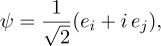
the boson matrix has exactly two non-zero entries:

The phase of Bij is always −π∕2. Always. For any hop distance, any chain length, any encoding. A quarter-turn in the complex plane is the defining property of a propagator. This is what a virtual photon does in quantum electrodynamics. We did not put it there.
The four-hop structure is immediate: four successive hops accumulate a total phase of 4 × (−π∕2) = −2π, returning the system to its original state. This is the spinor double-cover structure of spin-1∕2: a 2π rotation returns a fermion to its state only up to a sign, while a 4π rotation is the identity. Spin-1∕2 is not a postulate. It is the phase arithmetic of an imaginary-valued codec.
When two fermions hop simultaneously, every boson matrix entry retains the universal −π∕2 phase inherited from the individual hops, but acquires additional phases 0 and +π∕2 corresponding to inter-fermion correlations with no single-particle analogue. The two-fermion boson is a superposition of single-hop bosons plus an interaction residual.
A further result emerges: fermions crossing — passing through each other — produce an identical boson matrix to fermions moving in the same direction. The codec records only initial and final pixel configurations, not trajectories. Path independence falls out for free.
Two fermions assigned to the same site produce a wavefunction ψ ∝ ej localised on a single site. For this state, B = 0 exactly. The density matrix is:

which vanishes off-diagonal for i≠k since both i = j and k = j cannot hold simultaneously. Double occupancy produces no boson. It has zero compression residual. It is informationally invisible.
Pauli exclusion is not a law imposed on the system. It is the statement that double occupancy has nothing for the codec to record.
The central quantitative result. Consider a fermion in superposition between sites i and j:

where 𝜃 = 0 is the fermion stationary at site i, 𝜃 = π∕4 is equal superposition, and 𝜃 = π∕2 is the fermion fully arrived at site j.
Theorem.
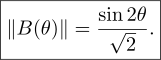
Proof. The off-diagonal entries of ρ in the i,j subspace are:

All other off-diagonal entries are zero since ψk = 0 for k≠i,j. Therefore:

Taking the square root gives the result. The proof uses only the definition B = ρ − diag(ρ) and the normalisation of ψ. It is independent of L, the separation |i−j|, and any overall phase on ej. Numerical verification confirms agreement to within floating-point precision (< 4 × 10⁻¹⁶) for all chain lengths tested. □
The theorem has an immediate consequence. Let P = sin2𝜃 be the Born-rule probability that the fermion occupies site j. Then:

The boson amplitude is  times the geometric mean of the hop and no-hop probabilities. This is the
interference term of the Born rule, made visible as a matrix norm.
times the geometric mean of the hop and no-hop probabilities. This is the
interference term of the Born rule, made visible as a matrix norm.
The boson amplitude is not an approximation or an emergent average. It is the exact quantum interference encoded in the density matrix, derived from the single definition B = ρ − diag(ρ).
The formula ∥B(𝜃)∥ = sin(2𝜃)∕ traces the complete lifecycle of a virtual particle:
 . The
compression residual is at maximum amplitude.
. The
compression residual is at maximum amplitude.
This is the propagator of a virtual particle — the fundamental object of quantum electrodynamics, the mechanism by which forces are exchanged in QED. We derived it from the definition of matrix subtraction applied to a normalised wavefunction. No quantum field theory was postulated. No interaction term was introduced. The virtual photon is the mathematical ghost left in the codec while a pixel is in transit.
The six experiments establish four results, each analytically exact:
 with a universal −π∕2
phase, independent of chain length, hop distance, and encoding.
with a universal −π∕2
phase, independent of chain length, hop distance, and encoding.
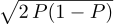 , where P = sin2𝜃 is the Born-rule hop
probability. The boson amplitude is the interference term of the Born rule.
, where P = sin2𝜃 is the Born-rule hop
probability. The boson amplitude is the interference term of the Born rule.
 over the fermion’s journey.
This is the virtual particle lifecycle, derived without field theory.
over the fermion’s journey.
This is the virtual particle lifecycle, derived without field theory.All four results follow from the single definition B = ρ− diag(ρ). No coupling constants, interaction terms, or postulated particle species were introduced anywhere.
The experiments use a one-dimensional chain with a single fermion. Three extensions are needed to reach the full Standard Model.
Many-fermion systems. The one-fermion codec must be extended to N-fermion systems via tensor products. The key question is whether the antisymmetry of fermionic Fock space — ψ(x1,x2) = −ψ(x2,x1) — emerges from the boson matrix structure or must be imposed separately. The antisymmetry of B found in Experiment 2 suggests it may emerge naturally.
Massive bosons. The present paper identifies a photon-like boson: massless, antisymmetric, universally phased. The W, Z, and Higgs bosons require massive mediators with different propagator structure. A natural direction: massive bosons correspond to compression residuals from transitions between inequivalent vacua that do not vanish at the endpoints 𝜃 = 0,π∕2.
The electromagnetic force law. The 1∕r2 force law should follow from the same graviton flux argument applied to the n = 2, m = 1 fermion’s antisymmetric residual. The derivation is not yet complete.
The next chapter extends the fermion complexity classes to the full particle spectrum and derives what the codec geometry implies about quarks, leptons, and confinement.