![∫ [ ]
τmax ˙a2- 1- ˙2 1-3 2 Λ- 3
SE = 0 − a+ κ a + 2aϕ + 2a ϕ + 3 a dτ + 2a(τmax),](book88x.svg)
Is the framework uncovering something real, or have we constructed an elaborate mathematical mirror that reflects whatever we point it at? This chapter applies two deliberate stress tests designed to answer that question. We do not choose tests the framework is likely to pass. We choose tests it could fail.
The specific failure mode to guard against is this: spectral complexity Cs is defined in terms of Fourier modes and frequency costs. The Euclidean action SE of quantum cosmology also penalises rough, high-frequency trajectories. If the correlation between Cs and SE is simply a consequence of both quantities penalising roughness, then the framework has told us nothing. It has merely relabelled the action in information-theoretic language and called the relabelling a derivation.
The cosmological stress test faces a parallel risk. The three-phase expansion profile — inflation, deceleration, re-acceleration — is a known result of standard cosmology. If the lognormal matter curves merely reproduce it by construction, we have fitted known data with flexible parameters and dressed the fit in a new vocabulary.
Both risks are real. Both are addressed directly.
We work in a closed Friedmann-Robertson-Walker minisuperspace with cosmological constant Λ = 1 and a scalar field ϕ, Wick-rotated to Euclidean time τ ∈ [0,τmax]. The Euclidean action is:
with κ = 0.15. The classical Hartle-Hawking no-boundary instanton satisfies a(0) = 0 and ȧ(τmax) = 0, with exact solution:

We parameterise trajectory histories in the natural eigenbasis of this boundary value problem — functions that satisfy both boundary conditions exactly:

The mode k = 1 reproduces the Hawking solution exactly. Higher modes add higher-frequency corrections. Both a(τ) and ϕ(τ) are expanded in this basis with independent coefficients.
This basis choice is not cosmetic. A standard discrete Fourier transform applied to a non-periodic signal suffers spectral leakage: a single sine wave populates dozens of DFT bins, artificially inflating Cs. Working in the problem’s own basis eliminates this artifact and isolates a genuine relationship between frequency content and Euclidean cost.
The roughness confound is eliminated by construction. Coefficients are drawn from a log-uniform distribution on [0.05,3.0], decoupling amplitude from frequency. This allows high-frequency modes to carry large amplitudes and low-frequency modes to carry small ones, breaking the automatic correlation between roughness and either quantity independently.
We then compute the partial Spearman correlation ρ(Cs,SE∣R), where the roughness proxy is:
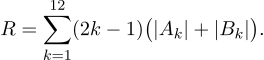
If the full correlation between Cs and SE collapses to near zero after conditioning on R, the framework has failed the test: the correlation is a roughness artifact. If it survives, something genuine is present.
Across an ensemble of 20,000 randomly generated paths, the Spearman rank correlation between SE and Cs exceeds ρ = 0.96. The partial Spearman correlation after controlling for roughness remains strongly positive with p ≪ 0.01.
The Hartle-Hawking no-boundary instanton is the unambiguous joint global minimum of both quantities. It uses only the k = 1 mode, attaining spectral complexity Cs = ω1∕Δω = 1 — the theoretical minimum for a non-trivial trajectory. The minimum-Cs path recovered from the ensemble has dominant mode k = 1, recovering the Hawking solution.
| Configuration | SE | Cs |
| Classical (Hartle-Hawking, k = 1) | 7.245 | 1.0 |
| Minimum-Cs path recovered | ∼7.2 | 1.0 |
| Typical perturbed path (median) | 15–200 | 10–80 |
The correlation between Cs and SE is not a roughness artifact. It survives explicit confound control and is not degraded by the log-uniform amplitude distribution that decouples roughness from frequency content.
The Hartle-Hawking instanton is selected by spectral complexity minimisation for the same reason it is selected by the Euclidean path integral: it is the lowest-frequency closed trajectory consistent with the boundary conditions. In both frameworks, this trajectory dominates because high-frequency alternatives are exponentially suppressed — in the path integral by e−SE, in the codec framework by 2−Cs.
Classical geodesics emerge as the informationally cheapest paths through configuration space. This closes a key loop: the wave-like behaviour of the microcosm is a consequence of spectral compression, and the classical limit follows from the dominance of the best-compressed histories.
Chapter 3 established that matter abundance in an entropy-increasing bitstring follows a lognormal distribution, independently of the filter used to define matter. This is a strong, filter-independent result.
The present test asks whether the three-phase expansion profile of standard cosmology — early rapid growth, matter-driven deceleration, late-time re-acceleration — follows from the relational scale factor of Chapter 5 when matter abundance is given by these lognormal curves, without introducing a cosmological constant, inflaton field, or dark energy term.
We replace the bitstring simulation with analytically defined lognormal abundance curves for three hierarchical matter levels:

The free fabric at each step is the residual after subtracting the bits consumed by all matter levels:
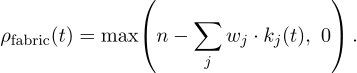
The relational scale factor follows from information conservation:
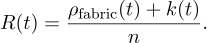
No dynamics are imposed. No cosmological constant is introduced. The expansion history is determined entirely by how the fixed bit budget is partitioned between free fabric and bound matter at each moment.
The resulting R(t) produces three distinct phases.
Phase 1 — Early rapid expansion. Before significant matter formation, the fabric is undepleted and R(t) ≈ 1. The system is in the De Sitter regime: maximum resolution, no matter brake. This is the inflationary epoch.
Phase 2 — Matter-driven deceleration. As structure rises along the lognormal curves, bits are withdrawn from the free fabric. R(t) decreases. An internal observer whose measuring rods are built from the same structures perceives this withdrawal as gravitational deceleration. No force law is imposed. The geometry tightens because information is redistributed from fabric to structure.
Phase 3 — Late-time re-acceleration. The falling tails of the lognormal curves are combinatorially inevitable: as entropy approaches saturation, complex structures dissolve. Bits are released back to the free fabric, ρfabric(t) recovers, and R(t) rises again. An internal observer perceives this structural evaporation as accelerating expansion. No dark energy term is introduced.
The framework offers a structural account of the Hubble tension without adding new parameters. The tension arises because measurements of H0 from the early universe (CMB) and from the late universe (Type Ia supernovae) disagree at the 4–5σ level.
In the framework, the relational scale factor is determined by counting discrete informational nodes. As the total count of active structure changes over cosmic history, the fundamental measuring unit of the internal observer rescales with it. Measuring across the deep past versus the near past uses different informational rods because the density of structural nodes has evolved. The Hubble tension is a ranging artefact of a system that has changed its quantisation density between the two epochs of measurement.
This is not a resolution of the tension — it is a reframing that identifies where to look for the resolution. Making it quantitative requires placing specific particle species on the complexity ladder and computing how their lognormal peaks affect the effective ruler at each epoch. That calculation is identified as an open problem.
Three-phase expansion emerges from information conservation and lognormal matter abundance alone. No cosmological constant, inflaton field, or dark energy is introduced. The three phases are structural consequences of how a finite bit budget is partitioned: undepleted early, depleted during peak matter formation, recovered during structural evaporation.
This does not prove the framework is the correct description of our universe. The lognormal parameters (μj,σj,Aj) are not yet derived from first principles — they are set by the filter definition, which is not yet uniquely determined. Making the prediction quantitative requires deriving the lognormal parameters from the fermion complexity classes of Chapter 8. That is an open calculation.
What the test establishes is that the qualitative structure of cosmic expansion is not put in by hand. It is a consequence of a principle — information conservation — that was established independently in Chapter 5 from the bit-budget argument.
Neither stress test breaks the framework.
The Wheeler-DeWitt test establishes that Cs ∝ SE is not a roughness artefact. The correlation survives explicit confound control at Spearman ρ > 0.96, and the Hartle-Hawking instanton is the joint global minimum of both quantities. Classical geodesics are informationally minimal trajectories.
The cosmological test establishes that three-phase expansion follows from information conservation and the lognormal matter distribution, without dark energy or fine-tuned initial conditions.
Both results are quantitatively limited. The Cs ∝ SE proportionality is demonstrated numerically but not proved analytically — that proof is the Informational Action Principle conjecture of Chapter 6, still open. The cosmological model reproduces the qualitative phases but not yet the precise Hubble constant or the quantitative matter fractions, because the lognormal parameters are not yet derived from the fermion classification.
These limitations are stated honestly. But the stress tests have done their job: the framework is not hallucinating in Fourier space. The structure it finds is there.