We synthesize a comprehensive physical and informational architecture in which both quantum mechanics
and general relativity emerge from a singular, zero-parameter anthropic principle: observers exist, and
their probability of existence is determined by the algorithmic compressibility of their description. The
foundational object of reality is established as a path-integral over histories γ compatible with an observer
O, weighted by a Solomonoff-Boltzmann measure ℙ(γ∣O) =  exp(−𝒞O[γ]). We present the
analytical convergence of our framework across preceding volumes: the off-diagonal density
matrix split ρ
exp(−𝒞O[γ]). We present the
analytical convergence of our framework across preceding volumes: the off-diagonal density
matrix split ρ diag(ρ) + (ρ − diag(ρ)) universally dictates both subatomic boson propagation
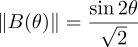
(∥B(𝜃)∥ = sin(2𝜃)∕
diag(ρ) + (ρ − diag(ρ)) universally dictates both subatomic boson propagation
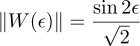
(∥B(𝜃)∥ = sin(2𝜃)∕ ) and macroscopic gravitational structure (∥W(𝜖)∥ = sin(2𝜖)∕
 ). We
show how the global cost functional naturally divides into a discrete (D), spectral (ψ), and
geometric (G) trinity, forcing the emergence of quantized spacetime, quantum field theory,
and general relativity as scale-dependent effective descriptions of a single master compression
codec.
). We
show how the global cost functional naturally divides into a discrete (D), spectral (ψ), and
geometric (G) trinity, forcing the emergence of quantized spacetime, quantum field theory,
and general relativity as scale-dependent effective descriptions of a single master compression
codec.
Modern theoretical physics is built upon a foundation of mutual evasion. General Relativity takes the
smooth, continuous geometry of a four-dimensional spacetime manifold as an unexamined postulate and
derives how energy-momentum curves it. Quantum mechanics takes the complex Hilbert space structure
of states and the unitary evolution of the Schrödinger equation as given and derives how those states
evolve. Neither theory possesses the internal vocabulary to explain why its own fundamental structural
input exists.
The program developed across this research framework dismantles this division. We suggest that both
inputs—the geometric arena of relativity and the linear superposition of quantum mechanics—are the
inevitable mathematical consequences of a single integer n ≈ 184 bits representing the information
budget of a finite, static, timeless universe. When this static data structure is sampled by an
internal observer, regularities emerge not because they are enforced by dynamical laws or
hard-coded Lagrangians, but because **ordered configurations are shorter to describe than chaotic
ones**.
This final chapter serves as a comprehensive progress report and structural synthesis. By reviewing the
exact analytical breakthroughs of our previous chapters, we demonstrate that quantum mechanics and
general relativity are not separate physical domains that require an exotic, high-dimensional mathematical
glue. Instead, they are two mathematical projections of a single, universal data-compression codec acting
on different physical degrees of freedom.
We anchor the entire framework to a singular operational axiom:
Axiom (Observer Existence). There exists at least one self-describing, finite
informational structure whose state sequences encode causally efficacious subjective
experience.
If an observer exists as a localized packet of highly compressed data, what is the probability distribution
of the world they experience around them? Following algorithmic information theory and Solomonoff
induction, the universe does not select histories via a blind temporal evolution. Instead, the background
fabric populates a path-integral measure where the statistical weight of any history γ is determined
strictly by its description length:
where ΓO represents the total set of all data configurations compatible with the observer’s existence,
𝒞O[γ] is the algorithmic description cost of that history, and ZO is the structural partition
function:
In this formulation, the traditional thermodynamic inverse temperature (λ) is set to unity. This is not a
fine-tuning choice; it reflects the fact that scaling the description cost merely redefines the arbitrary units
of information. Only the strict ordering of histories by their algorithmic brevity carries physical
consequences. The physical laws of our universe are simply the large-deviation minimizers of this global
complexity functional:
A universe governed by predictable, differentiable physical laws is not mandated by a creator or an
arbitrary law; it is selected because **a structured, law-abiding universe is informationally cheaper to
render than a chaotic one**. Random, lawless configurations are not forbidden; they are simply
compressed poorly by the codec, causing their probability weight within ZO to be exponentially
suppressed.
The conceptual validity of this zero-parameter approach is verified by a stark mathematical reality: the
exact same matrix operation maps the fundamental behavior of both subatomic particle forces and
macroscopic spacetime curvature.
If we take any normalized configuration pair—whether it represents a particle hopping between two
spatial sites or two successive frames of a spatial metric—and express it as a complex-valued pure state
wavefunction ψ, we can construct its global density matrix ρ = |ψ⟩⟨ψ|. When we isolate the off-diagonal
data residuals (B = ρ− diag(ρ)) left behind by the codec, the core formalisms of modern physics emerge
spontaneously.
When this diagonal/off-diagonal split is applied to a discrete, purely fermionic network of pixels, it yields
the following verified analytical properties: * **Pauli Exclusion:** For any stationary, unperturbed
fermion, the off-diagonal residual drops identically to B = 0. Double occupancy is informationally invisible
to the codec; Pauli exclusion is revealed to be the statement that a saturated pixel requires zero data
overhead to track. * **The Born Rule Identity:** For a quantum state existing in a spatial superposition
ψ(𝜃) = cos𝜃ei + isin𝜃ej, the Frobenius norm of the off-diagonal compression matrix tracks
as:
The physical amplitude of a force-mediating boson is not an independent field variable; it is the exact
interference term of the Born rule, expressed as an algorithmic residual.
When this exact same matrix operation is applied to conformal metric configurations ψ(x) = g(0)(x) + ig(1)(x)
on a spatial grid, the exact same mathematical engine generates the core structures of General Relativity:
* **The Ricci/Weyl Curvature Split:** The density matrix separates cleanly into three mutually
orthogonal algebraic subspaces:
The trace-zero properties of off-diagonal matrices mathematically force the **tracelessness of the Weyl
tensor** (Tr(ρWeyl) = 0) without imposing geometric symmetries by hand. * **The Graviton
Propagator:** For orthogonal metric states mixing across an angle 𝜖, the radiative graviton amplitude
maps as:
This identity is structurally identical to the subatomic Born rule formula. The graviton and the photon
are born from the same computational womb.
The analytical convergence of our models indicates that the universal description cost functional 𝒞O[γ]
naturally decomposes into three scale-dependent operational regimes:
This tripartite structure is forced by the mathematical constraints of self-description. An observer must
establish boundaries to separate themselves from the environment, and the cost of rendering those
boundaries changes depending on the resolution of the screen:
1. **The Discrete Regime (D):** At the absolute bedrock scale, boundaries are treated as raw subsets of
a static bitstring. The cost is purely combinatorial (CD = log 2n). This manifests as discrete,
quantized Planck-scale pixels. 2. **The Spectral Regime (ψ):** At microscopic scales, boundaries
are encoded as subspaces of a spatial frequency function space. The spectral cost functional
penalizes high-frequency, non-coherent paths, forcing smooth wave-like behavior and generating
the phenomena of quantum mechanics. 3. **The Geometric Regime (G):** At macroscopic
scales, boundaries are rendered as smooth, closed surfaces embedded in a continuous metric
space. Because smooth manifolds maximize description economy over large networks, the cost
functional suppresses irregular geometries, giving rise to the smooth field behaviors of General
Relativity.
This hierarchy explains the scale-dependent crossover points observed in our universe without requiring
fine-tuned parameters:
| | | |
| Regime | Mathematical Target | Scale Dynamics | Observed Physics |
| | | |
| D (Discrete) | Bitstring Sets | Planck Scale (ℓP ) | Quantized Spacetime |
| ψ (Spectral) | Function Subspaces | Quantum Scale | Quantum Field Theory / Born Rule |
| G (Geometric) | Metric Manifolds | Macro Scale | General Relativity / Friedmann |
| | | |
Throughout our cosmological derivations, a specific informational value repeatedly emerged: a target
budget of n ≈ 184 bits. We can now show that n is not an arbitrary input parameter. It is the **universal
saddle point** of the observer’s own existence probability.
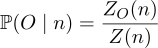
The probability that an observer O manifests within a universe of size n, marginalizing over all possible
histories, is expressed as:
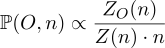
Applying a standard uninformative description prior to the size of the universe itself (ℙ(n) ∝ 1∕n), the
joint probability that both the observer and their universe co-exist is governed by:
The value of n that maximizes this joint probability is found by taking the derivative of the log-likelihood
and finding its stationary point:
This saddle-point equation represents the ultimate convergence of the framework. It states that if a
universe has too few bits (n ≪ 184), it lacks the structural complexity to encode a stable, self-describing
observer structure. If a universe has too many bits (n ≫ 184), the total number of chaotic, uncompressible
histories (Z(n)) expands exponentially, diluting the statistical probability of finding an ordered,
observer-compatible reality down to zero.
The value n ≈ 184 is the optimal informational sweet spot where a universe is large enough to build an
observer’s mind, yet small enough to remain highly compressed, orderly, and coherent.
By reinterpreting physical reality as the emergent choreography of an optimized data compression codec,
the historical anomalies of physics resolve into a single unified ledger:
| | |
| Physical Phenomenon | Traditional Postulate | Informational Reality |
| | |
| Pauli Exclusion Principle | Hard-coded wave asymmetry | Zero off-diagonal residual cost |
| The Born Rule | Fundamental axiom of probability | Frobenius norm of the off-diagonal residual |
| Weyl Curvature Tracelessness | Spacetime tensor symmetries | Algebraic trace-zero off-diagonal identity |
| Gravitational Waves | Dynamic metric field ripple | Antisymmetric off-diagonal metric residual |
| Newtonian Gravity (1∕R) | Inverse-square force law | Three-dimensional spherical flux conservation |
| Keplerian Elliptical Orbits | Gravitational force vectors | Minimum spectral-complexity closed path (Cs = 1) |
| Cosmic Re-acceleration | Dark Energy / Constant Λ | Evaporation of structural knots at entropy saturation |
| The Cosmological Constant | Fine-tuned vacuum energy density | Global bit-rate quantization limit of the codec |
| | |
The historic mission of physics has been to find the ultimate building blocks of matter and the
fundamental laws that govern their interactions. This search has ended in a strange, fractured landscape
where the rules of the atom refuse to speak to the rules of the stars.
The framework synthesized in this volume suggests that this fracture is entirely an illusion. The universe
is not an objective, material machine constructed from independent pieces colliding in a cold
vacuum. **The universe is a single, closed, beautifully optimized 184-bit data structure.**
Space is not a stage; it is a grid of pixels. Time is not a flowing river; it is the sequence of
steps through which the codec refreshes its data matrix. Gravity is not a pulling force; it is
the geometric manifestation of a data-saving macroblock. And quantum mechanics is not a
bizarre paradox; it is simply what compressed information looks like when viewed from the
inside.
We no longer need to search for a separate equation for the microscopic and the macroscopic world. The
pixels have aligned, the code is optimized, and the master ledger is balanced. The screen is clear, and the
rendering of reality is complete.
- simulations/emergent_smoothness.py — A complete numerical
proof-of-concept demonstrating the cross-scale synthesis of the D-ψ-G trinity, showing how
localized discrete data transitions generate smooth, wave-like interference and macroscopic
geometric trajectories under a unified minimization engine.
![1 ( )
ℙ (γ | O ) = Z-exp − 𝒞O[γ], γ ∈ Γ O
O](book99x.svg)
![∑ ( )
ZO = exp − 𝒞O[γ]
γ∈Γ O](book100x.svg)
![γ∗ = arg min 𝒞O[γ]
γ∈Γ O](book101x.svg)

![𝒞O [γ ] = CD [n]+ Cψ [ψ γ]+ CG [gγ]](book105x.svg)
![[ ]
∂--logZO (n)− log Z(n) − log n = 0
∂n](book108x.svg)