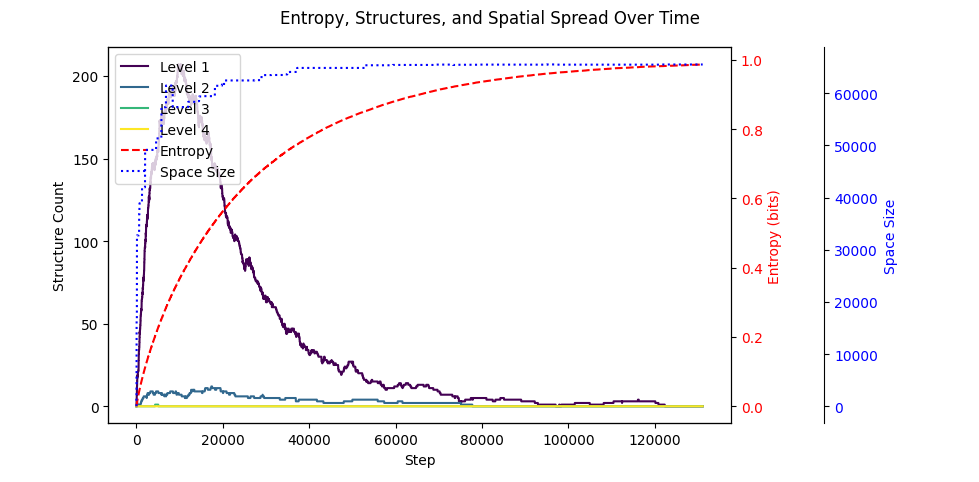
If an informational entropy collapse corresponds to physical geometric compression, then an increase in entropy must correspond to geometric unfolding. Under this framework, gravitational collapse and cosmological expansion are simply two opposite vector directions within the same underlying informational configuration space.
Instead of simulating a black hole’s collapse and observing how its execution trace entropy approaches zero, we can invert the arrow of time: we start with a zero-entropy execution trace and systematically mutate it to introduce information entropy. If our thesis holds, the corresponding geometric interpretation should unfold from a single point into a virtual, expanding universe.
In our previous black hole simulation, we treated collapsing dust particles as infinitely small, featureless points. In this inverted simulation, however, we expand our view to track both global spacetime geometry and its emergent local microstructures.
We initialize an execution trace at absolute zero Shannon entropy to represent the initial cosmological singularity. We then mutate the execution trace via random bit-flips, steadily increasing its expected Shannon entropy flip by flip.
To visualize this unfolding state, we introduce a decoding map that assigns subsets of bits to spatial coordinates, generating a discrete spacetime fabric. Upon this induced geometry, we apply simple, purely structural filters to identify emergent hierarchies:
An alternative method for identifying emergent matter is given by recursive bit-pattern detection. Here, the execution trace itself is treated as a one-dimensional candidate space of particles, bypassing the need for an explicit geometric mapping.
In this view, elementary particles are defined as short, highly repeated substrings. Composite particles are formed recursively by concatenating previously stabilized patterns; a composite structure is recognized if it appears frequently within the execution trace and if its constituent sub-patterns are already verified particles.
This recursive pattern-matching approach captures the emergence of matter purely from informational redundancy, independent of any explicit spatial embedding. The structural hierarchy is constructed strictly bottom-up: from frequent substrings (elementary particles), to composite concatenations (atoms), to repeated higher-order motifs (molecules).
It should be noted that both of these filters are deliberately minimal and arbitrary. However, they preserve two key scale-invariant features characteristic of our real universe: (i) the hierarchical nesting of matter, and (ii) the physical fact that particle sizes do not expand with the universe—only their mutual distances increase.
By counting the number of recursive particles at each successive entropy level, we observe a striking phase transition. While zero entropy yields absolutely no detectable structures, higher entropy states give rise to an exponentially growing population of emergent particles whose relative abundances follow a distinctive lognormal-like distribution.
The simulation reveals three key properties:
This model sits at the intersection of statistical mechanics, chaos theory, and the Self-Sampling Assumption of the anthropic principle. By assuming only that entropy increases and that observers apply structural filters to identify emergent patterns, a surprising number of cosmological properties emerge natively.
The model is philosophically appealing because it drastically minimizes metaphysical overhead. If the structured universe we observe is simply the most statistically probable outcome within an unguided configuration space, we remove the need for fine-tuned creative mechanisms. It happens simply because it is mathematically likely to happen. Under this framework, one could define any arbitrary filter and compute the direct probability for that specific structure to emerge out of raw noise. This represents a highly compelling, minimalist approach to a foundational Theory of Everything.
Across multiple independent mappings, decoding schemes, representations, and threshold choices, the abundance of emergent structures consistently follows a lognormal distribution.
In physics, lognormal distributions arise generically in systems governed by multiplicative stochastic processes, where growth proceeds through successive random amplifications rather than additive increments. This signature is observed throughout our actual universe, dominating phenomena such as cosmic particle clustering, galaxy mass distributions, biological growth rates, and socio-economic network hierarchies.
One of the deepest mysteries in modern science is why the fundamental laws and constants of physics appear to be meticulously fine-tuned to allow the existence of complex life.
If we model ourselves as one of these emergent substrings waiting to be found within the totality, where should we expect to locate ourselves? The answer is dictated by measure concentration: we should find ourselves near the peak of the lognormal curve, where the probability of emergent structures is highest. From this perspective, the observed regularity, scale hierarchy, and apparent fine balance of our universe are entirely unsurprising. They are merely the most typical properties of a populated configuration space.
The early universe is widely recognized to have inhabited a state of extraordinarily low thermodynamic entropy—a pristine condition that establishes the cosmological arrow of time and drives the evolution of macroscopic systems [13, 1]. Standard physics emphasizes that this initial order is essential for the subsequent emergence of structure [17, 9], yet it treats this low-entropy boundary condition as an unexplained, fine-tuned miracle.
Standard physics often points to the Heisenberg uncertainty principle and primordial quantum fluctuations to explain away perfect initial order. But doing so assumes the prior existence of quantum mechanics. What, then, gave rise to quantum mechanics itself?
Our information-theoretic perspective resolves this by treating spacetime geometry as a direct projection of information maximizing its entropy. An expanding universe and an increasing entropy budget are not separate phenomena; they are two sides of the exact same coin. Spatial expansion is merely the geometric translation of statistical relaxation. Our simulations demonstrate that an initial state of precisely zero entropy naturally gives rise to a rich, expanding, hierarchical reality without requiring fine-tuned initial parameters.
According to standard inflationary cosmology, the universe underwent an exponential phase of hyper-expansion during its earliest micro-moments to resolve the flatness and horizon problems. In our model, this inflationary phase is naturally accounted for: the rapid, initial expansion is the geometric interpretation of a system relaxing from a state of zero-entropy and evolving towards equillibrium.
When tracking the total number of emergent motifs, the geometric interpretations of information do not yield a perfectly uniform, flat spacetime. Symmetries within the bitstrings cause data to naturally cluster.
These clusters create local entropic gradients, directly biasing the spatial distribution of emergent structures. This provides a highly intuitive explanation for the fundamental nature of gravity: structures naturally drift toward regions of higher statistical weight because those configurations simply contain more available microstates. We do not experience a gravitational "pull" toward a massive object; rather, we experience a macroscopic statistical drift because there are simply more ways for our informational structure to exist down there than up here.
Despite these compelling features, our current exploratory model suffers from several profound structural flaws.
While complex motifs do emerge within the model, they fail to evolve smoothly along the continuous geodesics of a stable spacetime.
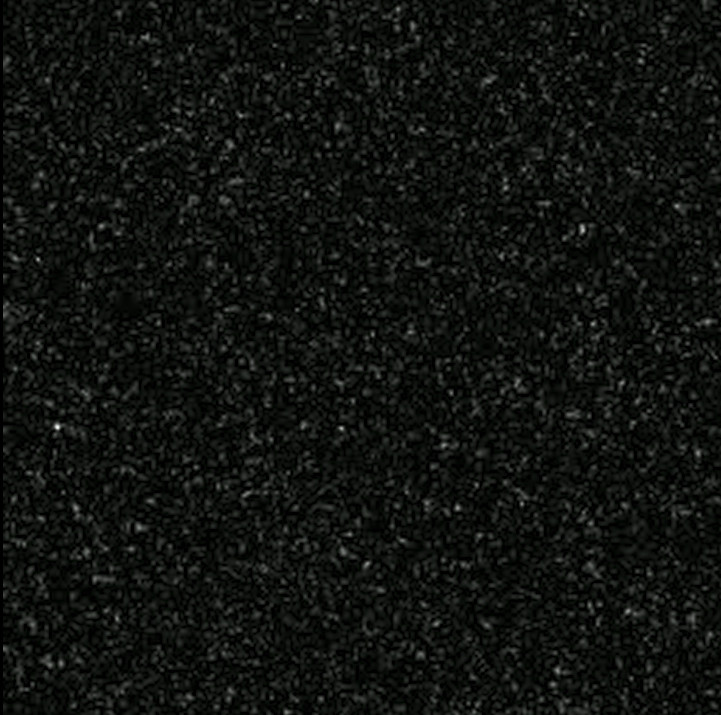
Instead of yielding elegant spiral galaxies or planets tracing predictable elliptical orbits, our simulation produces a chaotic, erratic "big-bang". No smooth General Relativity emerges, and there is no trace of a coherent, unifying quantum wavefunction. What we observe instead are transient, stochastic fluctuations that disintegrate haphazardly, obeying global statistical gradients rather than the strict, local regularities of physical law.
This stands in stark contrast to empirical reality: our universe overwhelmingly favors large, lawful, persistent structures over isolated, chaotic fluctuations.
One could attempt to invoke the Weak Anthropic Principle to explain away this chaos, arguing that we simply find ourselves within one of the incredibly rare, perfectly smooth, and lawful configurations hidden inside the noise because life cannot form within a chaotic explosion.
While this selection effect explains why our observations are conditioned on our survival, it leaves the framework with virtually zero predictive power. It turns the theory into a tautology rather than a predictive mathematical framework.
Furthermore, we have deliberately start out from perfect order. Why do we find ourselves in a forward-running arrow of increasing disorder and an expanding universe, rather than a contracting one?
We may owe our very existence as reasoning agents to this entropic increase. In semi-hostile environments where structures naturally decay, intelligence functions as a highly specialized local filter designed to "fight back" by actively generating local order [11].
Intelligence could not function in a universe with a decreasing entropy budget where systems naturally drift toward perfect order on their own. We sustain our local metabolic loops by consuming low-entropy fuel—such as the highly ordered structure of a banana—and breaking that order down into high-entropy waste.
To maintain an identity in a time-reversed, decreasing-entropy universe, our metabolism would be inverted: instead of eating banana and excreting metabolic waste, we would be forced to eat metabolic waste from our environment and, through some miracle of reverse-biology excrete low-entropy bananas.
At least we are exceptionally lucky to live on the side of the entropic curve where breakfast goes in as order and leaves as waste, rather than the other way around.
If our foundational axioms are correct, an observer like Alice must emerge from this noise. Yet, our raw statistical simulations fail to capture her. The exact probability that a complex observer—complete with an understanding of Einstein’s field equations, quantum mechanics, and a continuous, deterministic wavefunction—would spontaneously crystallize out of a purely random bit-flip mutation is practically zero.
This gap raises fundamental questions. For example, why do we observe that everything at the smallest scale of the cosmos behaves as a wave? Furthermore, even if we assume that the emergent microstructures detected by our filters serve as the seeds of matter, why do they exert a gravitational pull?
Explaining these phenomena within the constraints of the current model is extraordinarily difficult. Either our fundamental approach is incorrect, or we are missing an essential piece of the puzzle.