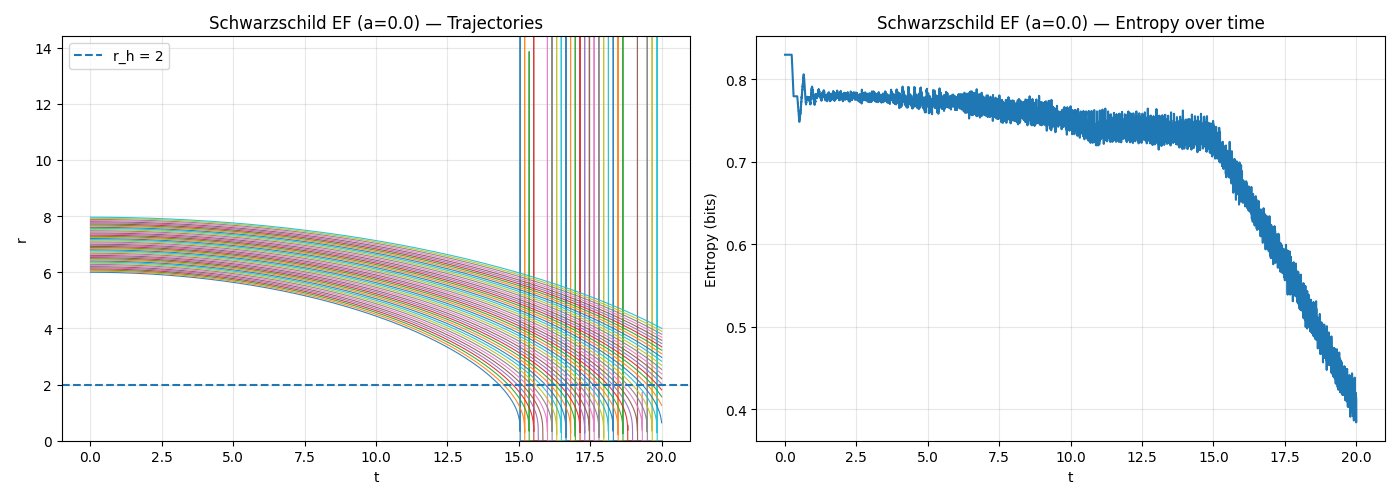
Let us test the consequences of treating a simulated system and its simulator as two perspectives of the same underlying information. Under this framework, a computer running a simulation and the simulated universe itself are simply dual descriptions of a single informational structure.
If this equivalence holds, what insight does it offer into the most bizarre and pathological object in our universe—one that classical physics still fails to fully comprehend?
The black hole singularity.
According to General Relativity, all matter crossing the event horizon eventually collapses into a point of zero spatial volume and infinite density. An entire star—millions or even billions of times more massive than the Earth—is compressed into a region of vanishing volume. This description profoundly strains physical intuition.
By constructing a black hole simulation and treating the program execution and the emergent spacetime geometry as equivalent informational states, we can gain an entirely new perspective on these pathological points in classical geometry.
Computers are deterministic state machines. Each executed CPU instruction drives the system from one discrete state to the next. In software engineering, an execution trace is the chronological record of this state trajectory. If the source code represents the laws of physics, the execution trace is the complete spacetime history of the universe it generates.
Consider a simulation tracking a massive, spherical dust cloud as it collapses under its own gravity to form a black hole. In computational practice, we cannot run such a simulation to its absolute mathematical conclusion. As the collapse approaches its final state, the software inevitably crashes.
This failure is driven by two factors: the fundamental breakdown of the classical Einstein field equations and the inherent limitations of our digital floating-point tools. Long before the physical singularity is reached, the execution trace is overwhelmed by division-by-zero exceptions and numerical infinities that instantly exceed the bit-width precision of the system’s hardware.
General Relativity predicts singularities, but its smooth, continuous geometry lacks the toolkit to describe them. However, because General Relativity is fundamentally a theory of geometry, the ultimate nature of this computational breakdown must be geometric.
In our simulation, each dust particle and every discrete coordinate of the spacetime fabric maps to a unique sequence of memory bits. Together, these elements form a continuous bitstring representing successive temporal slices of the spatial configuration.
Initially, the bitstring encoding the highly disordered dust cloud possesses maximum entropy and high descriptive complexity:
00100101011110101010101001010100101010101010101001001001110101010010100101010...
...
As the simulation evolves toward a black hole, an extraordinary inversion occurs. While the global thermodynamic entropy of the system satisfies cosmological bounds, the informational entropy (the Kolmogorov complexity) of the bitstring encoding the spatial geometry radically decreases. The geometric configurations become increasingly uniform, uniformized, and redundant:
...
0001000010000010010001000000001000100000000000001000010000000010000000100010000...
0001001000000000010000000000000010000010000000001000000000000000000100000000001...
0000001000000000000000000000001000000000000000000000100001000000000000000000100...
...
[hardware exception: division by zero / arithmetic overflow]
Even though numerical instabilities prevent the machine from registering the final state, the trajectory is mathematically clear. By extrapolating the trend of the execution trace, we arrive at a definitive conclusion:
Principle 25.2.1: The Singularity Inversion
The classical black hole singularity corresponds to a state of absolute zero informational entropy.
In classical physics, gravitational curvature diverges to infinity because physical geodesics converge to a point. However, our informational framework suggests that this infinity is merely a artifact of an exhausted descriptive framework—analogous to the mathematical divergence of surface derivatives when evaluating coordinates at the exact North Pole of a smooth sphere.
Remarkably, this zero-entropy conclusion is entirely invariant under coordinate choice, representational mapping, or dimensionality. If you map a zero-entropy bitstring (such as a string consisting entirely of zeros) back to a geometric interpretation, it can only yield one possible object: a single, featureless point.
Thus, singularities are not terrifying regions of infinite physical massiveness, but the exact opposite: states of complete informational exhaustion. They are the simplest, most trivial geometric configurations possible.
Because a zero-entropy bitstring is fundamentally incapable of encoding or describing internal microstructures—such as the discrete states of incoming particles—it offers a beautiful, elegant solution to the paradox of the singularity:
The probability of any falling particle actually existing inside the singularity is zero. The singularity is simply too structurally trivial an object to hold them.
By shifting our perspective from continuous geometry to discrete, self-interpretive information, one of the greatest mysteries of modern astrophysics is revealed to be the ultimate expression of simplicity—an elegant baseline of zero data that any software engineer can inherently understand.