In the previous chapter we derived a single integer — n ≈ 184 bits — that fixes the resolution of space and time for our universe. That derivation treated the universe as an empty system, a pure information budget with no internal structure. Now we ask what happens when matter enters the picture.
The answer will not require a new force. It will not require a field equation. It will require only one principle, already implicit in everything that came before: the bit budget is fixed. Every bit spent on matter is a bit withdrawn from the fabric of space.
Think of the universe’s 184-bit budget as a length of rope. When the rope is smooth and uniform, every segment is independently addressable. An observer running their fingers along it encounters distinct positions, one after another.
Now tie a knot. The material of the rope is conserved — nothing has been added or removed. But a section of the rope has been drawn inward and bundled. If you stretch the rope out, its total navigable length has shrunk. The bits caught in the knot are no longer available as independently addressable positions along the background.
This is exactly what happens when matter forms. At any moment, the n bits of the universe are partitioned between two roles:
Because no new bits can be injected from outside, this is a strict zero-sum partition. If m(t) bits have been consumed by matter structures at moment t, then
Every bit locked into a particle is a bit subtracted from the spatial fabric available to an internal observer.
An observer inside the universe cannot step outside and measure it with an external ruler. They can only count the structures available to them: the free fabric tokens and the composite matter entities. The resolution of observable space — the number of independently distinguishable positions — is the total of both.
When one composite structure of width w bits forms, it consumes w fabric tokens and creates 1 matter entity. The new resolution is:

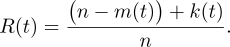
Resolution decreases by w − 1 for every structure that forms. If m(t) bits have been consumed and k(t) composite entities exist, the total resolution is:

Normalised to the maximum possible resolution of an empty universe, this defines the relational scale factor:
| (5.1) |
This is a pure counting statement. No metric tensor. No field equation. No force law. Just: what fraction of the bit budget remains independently addressable to an internal observer?
The two most celebrated exact solutions of General Relativity emerge directly as the extreme values of equation (5.1).
The De Sitter limit. Set m = 0 and k = 0: no matter has formed, all bits are free fabric. Then R = 1. The spatial grid retains its maximum addressable resolution. An internal observer perceives pure exponential expansion without bound — exactly the De Sitter vacuum solution of GR with a positive cosmological constant and zero matter density.
The Schwarzschild limit. Set m = n and k = 1: every bit in the universe has been consumed into a single composite entity. Then:
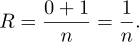
The observable resolution of space has collapsed to a single isolated coordinate. Space has effectively vanished. This is the informational counterpart of the black hole singularity established in Chapter 2 — and it arrives here not as an assumption but as the natural far end of the same counting equation that gives De Sitter at the other extreme.
These are not two separate mathematical discoveries about different aspects of gravity. They are the two endpoints of a single information-conservation spectrum. Every state of the observed universe — expanding, matter-filled, approaching equilibrium — is a point somewhere between them.
The Friedmann equation governs the expansion of a homogeneous, isotropic universe in General Relativity:
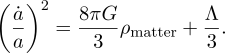
The present framework maps onto this equation under identifications that follow directly from the counting argument:

These are not free parameters fitted to observation. They are definitions. Matter density is the fraction of the budget currently locked into bound entities. The cosmological constant is the fraction that remains free. The scale factor is the addressable resolution fraction.
Read this way, the Friedmann equation is not a dynamical law imposed on spacetime. It is a counting identity, a statement about how the bit budget is partitioned at each moment in the entropy evolution of the universe.
For decades, quantum field theory has predicted a vacuum energy density roughly 10120 times larger than the observed value of Λ. This is often called the worst prediction in the history of physics.
The framework dissolves the problem by removing its premise. The cosmological constant is not a property of the vacuum in this picture. It is not an energy density of empty space at all. It is the fraction of the bit budget that happens to be unbound at this cosmic epoch — a dimensionless ratio between zero and one, bounded above by the finite integer n.
There is no infinite vacuum energy to cancel. There is only a fabric density that grows when matter decays and shrinks when matter forms. The 10120 discrepancy is a consequence of mistaking a counting ratio for an energy density. The quantities are not the same thing.
In General Relativity, matter curves spacetime through the stress-energy tensor — matter tells spacetime how to curve, spacetime tells matter how to move. The mechanism is geometrically precise but physically unexplained. Why does matter curve space at all?
In this framework the answer is direct. A composite structure consumes fabric tokens from the surrounding region. The local density of independently addressable positions drops. An observer navigating toward the structure finds fewer and fewer resolvable positions between themselves and it. This depletion of local resolution is what they experience as gravitational attraction. Space curves near a mass because the mass has consumed the very bits needed to render the background between them.
Gravity is not a force thrown across empty space. It is the geometric consequence of an informational redistribution — the same knot-in-a-rope phenomenon, read from the inside.
The counting equation (5.1) is intrinsically one-dimensional: it counts bits along a linear budget. The observed universe is three-dimensional and spherically symmetric. The bridge between the two is the same 4π factor that appeared in Chapter 2 when recovering the Bekenstein–Hawking entropy:

Projecting the linear bit-depletion curve through a spherical surface converts it into the quadratic density profile found inside the event horizon of a Schwarzschild black hole. The geometry follows the data. The 4π factor is not introduced by hand — it is the unique conversion between a one-dimensional radial information count and a three-dimensional spherical observable, the same conversion that appeared in Chapter 2 and will reappear whenever the framework transitions between informational and geometric descriptions.
Two results follow from the information-conservation argument.
First, De Sitter space and the Schwarzschild singularity are the two extreme values of a single counting equation. De Sitter corresponds to all bits free; Schwarzschild corresponds to all bits bound into one entity. General Relativity’s two boundary solutions are not independent discoveries. They are the endpoints of one information-theoretic spectrum.
Second, the Friedmann equation maps onto the framework under explicit variable identifications that follow from the counting argument alone. The cosmological constant is the free fabric fraction. Matter density is the bound entity fraction. The scale factor is the addressable resolution fraction. No constants are fitted. No forces are introduced.
What the framework has not yet explained is why individual particles, moving through this information grid, behave the way they do at small scales — why their trajectories are probabilistic, why they interfere, and why measurement produces a definite outcome. That is the question the next chapter answers. The same spectral complexity functional that resolved the singularity and selected Keplerian orbits will now be shown to produce quantum mechanics.