
In the previous chapter we watched a universe assemble itself from nothing but an entropy-increasing bitstring. Expansion, matter tiers, and the arrow of time all emerged without a single hardcoded physical law. But qualitative emergence is not enough. A serious theory must produce numbers — specific, checkable predictions that can be compared against observation.
This chapter asks a precise question: if the universe operates on a finite bit budget of n bits, what is the exact resolution of space and time? The answer will be a single integer. And that integer, derived from one measurement, will correctly predict two completely independent results from cosmology and black hole physics.
A universe of n bits has exactly 2n distinct configurations. If space is the geometric reading of informational variety, then 2n is the maximum number of distinguishable spatial positions the system can represent. We identify each position with one Planck length — the smallest length scale physics can define — giving a maximum radial extent of
Time requires a different argument. Time, as established in Chapter 1, is not an external parameter but an internal ordering relation: the sequence of states an observer traverses as the system evolves from its zero-entropy initial state toward thermodynamic equilibrium. The natural unit of time is therefore not an arbitrary clock tick but the number of bit-flip steps required to bring a zero-entropy system to full saturation.
This is a classical result from combinatorics known as the coupon-collector problem. If you flip bits one at a time, randomly and uniformly, it takes on average

steps to visit every one of the n bit positions at least once — that is, to reach full statistical equilibrium. Identifying one bit-flip with one Planck time:

These two resolutions — one exponential in n, one quasi-linear — define the geometry of the spacetime block. Their ratio is the key quantity.
Dividing the spatial resolution by the temporal resolution gives a dimensionless number:
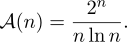
We call this the aspect ratio of the spacetime block. It is not a free parameter. Given n, it is fixed. It encodes the complete geometric relationship between the spatial and temporal extent of the universe from a single integer.
Because 2n grows exponentially while nlnn grows quasi-linearly, the aspect ratio is strictly increasing: larger bit budgets produce universes where space is exponentially larger relative to time. This monotonicity has an immediate corollary. Any subsystem of the universe — a black hole, a galaxy, a particle — has a smaller bit budget than the whole, and therefore a strictly smaller aspect ratio. The hierarchy is structural, not assumed.
To find n for our universe, we need a physical measurement that can be identified with 𝒜(n). The inflationary epoch of the early universe is the natural candidate. Inflation is, physically, the closest realisation of what the model describes: a system expanding rapidly from a near-zero-entropy initial state.
Standard cosmology gives the following values for the inflationary epoch: a duration of approximately 10−35 seconds and a radial expansion of approximately 1026 metres. To compare these against 𝒜(n), we must strip away human units and express both in Planck units:


The dimensionless inflationary aspect ratio is then:

Setting 𝒜(n) = 𝒜inf and solving numerically:

One measurement. One integer. That is the universe’s bit budget.
Standard inflationary cosmology requires, independently of anything above, that the early universe underwent a minimum of 60 e-folds of exponential expansion — about 87 doublings on a base-2 scale — in order to explain why the universe looks so flat and uniform today. This lower bound comes from a completely different line of reasoning: the horizon and flatness problems of classical cosmology.
A bit budget of n ≈ 184 corresponds to approximately 127 natural-log units of expansion capacity.
We did not use the e-fold count to fix n. We fixed n from the Planck-unit ratio of inflationary spatial and temporal scales. The fact that the result comfortably exceeds the independent cosmological lower bound of 60 e-folds — with 127 natural-log units, or about 183 base-2 doublings of spatial depth — is a non-trivial consistency check from a completely separate branch of physics.
If n ≈ 184 describes the full universe, what happens when we apply the same framework to a smaller, localised system? A black hole is the natural test case: it is a zero-entropy sink (the singularity, from Chapter 2) surrounded by an information boundary (the event horizon). Its characteristic length scale is the Schwarzschild radius rs.
By direct analogy with the universe, whose spatial resolution 2n was identified with a radial length in Planck units, we assign the black hole a local bit budget:

For a solar-mass black hole, rs ≈ 2950 metres, giving:

Note that 127 < 184, as required by the monotonicity result: a black hole is a subsystem of the universe and must carry a strictly smaller bit budget.
The event horizon is a two-dimensional surface. By the same logic that gives 2n as the one-dimensional spatial resolution, the two-dimensional surface resolution is 22nbh Planck areas. The predicted physical surface area is:

The Bekenstein–Hawking formula, derived from semiclassical general relativity, gives:

The ratio between the two predictions is:
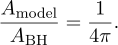
The discrepancy is exactly 4π — the ratio of a flat square of side r to the surface area of a sphere of radius r. It is not a failure of the model. It is the signature of spherical geometry. The event horizon is a sphere because General Relativity demands it. The information-theoretic calculation computes a flat raster area; multiplying by 4π to convert to a spherical surface recovers Bekenstein–Hawking exactly:

This 4π factor is the same geometric conversion that appeared in Chapter 2 when we discussed holographic consistency. Its reappearance here is not a coincidence. It is the unique factor demanded whenever a one-dimensional radial information count is compared to a three-dimensional spherical observable — the precise boundary between the informational and geometric descriptions of the same object.
The derivation above introduced no fundamental constants of physics. Newton’s gravitational constant G, the speed of light c, and Planck’s constant ℏ appear nowhere in the information-theoretic calculation. They enter only at the very end, when we translate back into human units — metres, seconds, kilograms.
This is not an accident. In the framework, G, c, and ℏ are unit conversion factors between the informational description and the human measurement system. They are not inputs to the physics. They are outputs of the choice of units. The physics is the bit count n. The constants are the dictionary between n and the numbers on our measuring instruments.
Three results follow from the aspect ratio argument.
First, a single integer n ≈ 184 encodes the full geometric structure of spacetime. Spatial resolution, temporal resolution, and their ratio are all determined by n alone through 𝒜(n) = 2n∕(nlnn).
Second, the e-fold count of inflation — derived entirely independently from the horizon and flatness problems — is consistent with n ≈ 184. The two calculations were done in different branches of physics and agree.
Third, the Bekenstein–Hawking entropy of a solar-mass black hole is recovered from the local bit budget nbh = log 2(rs∕ℓP ), up to the factor 4π that converts flat raster geometry to the spherical geometry demanded by GR. No constants of physics are introduced; they emerge from the unit conversion at the end.
The next chapter asks what happens when an observer is placed inside this 184-bit spacetime and attempts to describe what they see. The answer is quantum mechanics.