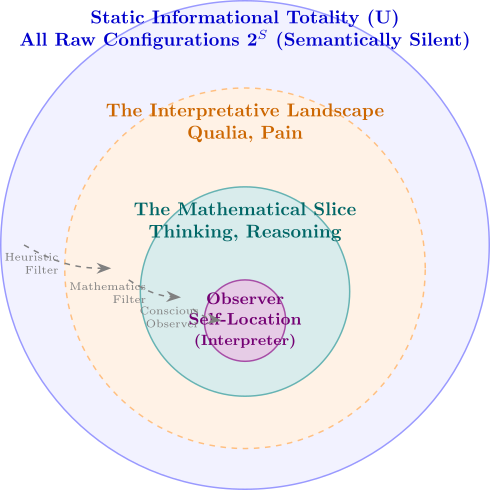
The hard problem of consciousness [2] asks why physical or computational processes should be accompanied by subjective experience (qualia). If a system’s physical evolution or program execution is fully causally closed, qualia appear epiphenomenal—causally inert additions to a machine.
It is easy to understand an advanced AI that becomes aware of its own thinking. But it is difficult to see how it could “feel” pain.
Why should a purely mechanical process feel like anything at all?
A calculator can process numbers without suffering. A thermostat can regulate temperature without loneliness. Why should a human brain be different?
As established by preceding chapters, we start with the following axioms:
Observers are finite informational structures.
An observer is not a metaphysical soul or externally animated object, but a self-contained informational configuration.
Everything an observer can know or experience must be encoded within its informational structure.
No external metaphysical signals, hidden carriers of meaning, or ontologically privileged channels may be invoked.
Raw information possesses no intrinsic semantics.
A finite informational structure admits an enormous—effectively unbounded—space of possible interpretations, mappings, and relational embeddings.
The interpretation space is combinatorially intractable and cannot be exhaustively traversed algorithmically without explosion of description length.
Observers experience stable mathematical regularities as fundamental reality.
However, these regularities arise only after aggressive interpretive compression and stabilization.
Mathematics is therefore epistemically primary for the observer, but not ontologically primary in the total informational landscape.
From Axioms 1 and 2:
All explanatory entities must ultimately reduce to informational structure and its interpretation.
There is no room for additional metaphysical substances or externally injected meanings.
From Axiom 3:
If raw information admits arbitrarily many incompatible interpretive schemes, then no unique mathematical structure can be globally privileged at the foundational level.
Stable mathematics emerges only as a highly constrained subset of interpretive space.
From Axiom 3 plus observer finiteness:
Exhaustive interpretive evaluation is computationally impossible.
Therefore finite observers must rely on heuristic filters to navigate interpretation space.
Subjective experience corresponds to the internal phenomenology of these heuristic selection processes.
Qualia are not inserted into mathematics; they arise at the interpretive-compression layer preceding stabilized formal structure.
The hard problem rests on a hidden premise: the assumption that a specific computational or mathematical structure is ontologically fundamental.
Under the ??, this premise fails.
Raw information carries no intrinsic semantics.
What appears to us as mathematics and a causally closed physical universe may constitute only a highly constrained subset of the total interpretive landscape.
Qualia do not need to insert themselves into a causally closed mathematical structure.
Instead, subjective experience operates entirely at the level of the interpretation space itself.
Just like GR and QM are two radically different layers of compression, so are rational thinking and human feelings, such as pain and joy.
Because the space of possible transition functions for an n-bit system grows combinatorially as (2n)2n , an intelligent observer cannot perform an explicit, exhaustive search for stable structures. The space is too vast to be algorithmically processed.
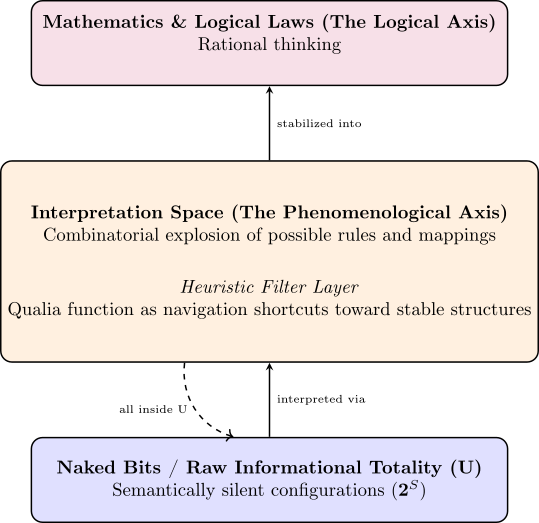
Therefore, to navigate this landscape, the observer relies on two fundamental axes of measure (layers of emergence):
1. The Logical Axis: Explicit symbolic manipulation, rule-based execution, and deduction within a stabilized interpretive scheme. This is the domain of logical reasoning, symbolic manipulation, and formal problem solving.
2. The Phenomenological, Heuristic Axis: Heuristic filters operating on the interpretation space. Feelings such as pain, joy, intuition, instincts, or aesthetic judgment are the internal, first-person experience of measure concentration over the interpretation space.
Qualia are the steering mechanics that guide the observer toward these rare, highly compressible, and relationally rich mathematical slices.
Let us answer to one final question: why does navigating high-measure compressible structures feel like searing pain, or the specific redness of red, rather than just some abstract "this way" signal?
The answer is: our life, our survival depends on it! Can you think of any more effective system to keep us alive?
The specific character of qualia—why pain hurts rather than merely registering as a neutral flag—is not mysterious under SIIP. It reflects selection on the induced measure over interpretation space. Observers whose heuristic dynamics concentrated toward survival-compatible stabilized slices persisted more reliably than others. Negative valence implements rapid, high-priority redirection away from high-entropy threats to self-coherence. Positive valence reinforces trajectories yielding stable, low-surprise worlds. This calibration provides a structural account for the intensity and qualitative character of experience
Consciousness does not emerge from math; rather, math is the pristine skeleton left behind when an intelligent observer’s heuristic filters successfully process raw, semantically naked information.
The "feeling" of experience reflects the structure of the interpretation space.
Principle 36.5.1: The Theory of Consciousness
Qualia are not additional objects inside mathematics. They are the internal signature of heuristic self-location within an intractable interpretive landscape.