
A central paradigm in theoretical physics is the pursuit of grand unification: the formulation of a single mathematical framework capable of describing all physical phenomena. The primary obstacle—and the essential first step toward this ’Theory of Everything’—is the synthesis of General Relativity and Quantum Mechanics into a coherent theory of Quantum Gravity.
But the wheels start to fall off the wagon almost instantly when applying the rules of QFT to the curved metric gμν of GR. In flat space, all inertial observers agree on the "vacuum" |0⟩. In curved space, this consensus evaporates.
Gravity stretches the field ripples. An observer in a stable region might see a vacuum, while an accelerating observer perceives a thermal bath of particles. This is the Unruh Effect, where the temperature T is proportional to acceleration a:
If observers cannot agree on whether a particle exists, the very definition of a "particle" as a basic building block begins to crumble. The framework ceases to provide a globally consistent notion of particles or vacuum.
The most jarring illustration of the incompatibility between Quantum Field Theory (QFT) and General Relativity (GR) is the Cosmological Constant Problem.
In QFT, the vacuum is never truly empty. Each field mode contributes a zero-point energy  ℏω. Summing
over all modes up to a cutoff frequency ωmax gives a vacuum energy density
ℏω. Summing
over all modes up to a cutoff frequency ωmax gives a vacuum energy density

If the cutoff is taken at the Planck scale, one obtains

Astronomical observations of the accelerating expansion of the universe, however, imply

The discrepancy is roughly a factor of 10120 — often described as the worst prediction in the history of physics.
Effects such as the Casimir effect confirm that vacuum fluctuations have measurable consequences. However, QFT only measures differences in vacuum energy. When coupled to gravity, the absolute vacuum energy should act as a cosmological constant and curve spacetime. Naively, the predicted energy density would curve the universe catastrophically. Yet observations show that the cosmological constant is extraordinarily small.
And if this wasn’t big problem enough, then there is the catastrophe of time, a cosmic crisis we foreshadowed in our chapters on quantum mechanics and general relativity.
In General Relativity, time is not an external parameter but part of its geometric structure. Space and time are interwoven, and their geometry is determined dynamically by the distribution of mass and energy. Objects trace world-lines through this geometry, and what we perceive as the present is a three-dimensional cross-section of a four-dimensional structure.
A common interpretation of General Relativity—the so-called block universe view—suggests that past, present, and future events all coexist within the spacetime manifold.
Quantum Mechanics offers a very different perspective. In quantum theory, physical systems are described by wavefunctions that encode all available information about their states. These wavefunctions evolve deterministically in time according to the Schrödinger equation.
Importantly, quantum mechanics does not render time itself indeterminate. Time remains an external parameter in standard formulations of quantum mechanics, unlike in General Relativity where it is part of the dynamical structure.
Drop General Relativity into a simulation and it breathes; the geometry ripples and reacts.
Drop Quantum Mechanics into a simulation and nothing happens.
One theory includes the clock; the other requires you to provide and wind it. This gap suggests that ’unifying’ them is not a matter of merging two lists of rules, but of reconciling two entirely different definitions of ’happening’.
And if we didn’t have enough problems already, there is an even more fundamental crisis looming. As observers, we are hard-coded to sense a simple, 3D Euclidean world.
But why? Why do we not instead experience reality as native inhabitants of a high-dimensional, complex-valued Hilbert space, perceiving ourselves as the wave-like entities we actually are?
If quantum mechanics is the fundamental truth of the universe, why does our conscious experience look like classical Einsteinian spacetime (3 + 1 dimensions, localized particles, and smooth gravity) instead of a state vector drifting through Hilbert space?
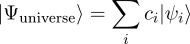 |
Mathematically, Hilbert space is where the real action happens. If we have N particles, they don’t live in our cozy 3D space; they live in a 3N-dimensional configuration space. When you factor in quantum states, the “state vector” of the entire universe, |Ψ⟩, is just a single point rotating in an almost infinitely high-dimensional Hilbert space.
Under this view, spacetime is an illusion. Our 3D space (plus 1D time) is just an emergent “projection” or a convenient holographic slice of this massive mathematical ocean. We are waves, not localized, “billiard ball” citizens of Einstein’s spacetime. We are insanely complex, highly entangled wavefunctions.
So, why don’t we feel like waves?
Quantum decoherence solves this problem—at least to some degree. As macroscopic objects (made of roughly 1027 particles), we are constantly being bombarded by photons, air molecules, and cosmic dust. Every time an environmental particle bounces off us, it “measures” our position. This interaction leaks our quantum phase information into the environment, effectively destroying our coherence. The fragile, high-dimensional interference of our wavefunction gets washed out, leaving behind a seemingly classical, localized, and highly stressed psychosocial object in 3D space.
Another explanation comes from entanglement (the idea that gravity is fundamentally quantum). The AdS/CFT holographic correspondence and the ER = EPR conjecture suggest that spacetime geometry is actually knitted together by quantum entanglement in Hilbert space. If you were to disentangle two regions of Hilbert space, the physical space between them would literally tear apart and grow infinite. Under this framework, we experience “Einstein” (spacetime and gravity) because gravity is just the thermodynamic, macroscopic manifestation of microscopic entanglement in Hilbert space.
But these are just technical explanations for why the universe behaves classically at the macroscopic scale. They don’t quite ease the existential itch.
Why Einstein? Why not Hilbert?