
Quantum mechanics is extraordinarily successful—arguably one of the most precisely tested theories in all of science. Its predictions have been confirmed to astonishing accuracy across a vast range of experiments.
At its core, quantum mechanics does not fundamentally describe particles, but rather the evolution of a mathematical object called the wavefunction. What we perceive as particles emerge as localized outcomes of interactions and measurements.
There is a fundamental duality: phenomena that appear particle-like in one context reveal wave-like behavior in another.
(Note that this chapter gets a bit equation-heavy, but let’s not panic. We’re mostly including them to look smart, establish our undeniable authority, and thoroughly impress any clueless readers who happen to stumble by.)
In experiments, we observe discrete events—localized detections that we call particles. These come in two broad classes:
Fermions include quarks and leptons. There are six types of quarks and six leptons (electron, muon, tau, and their corresponding neutrinos). These form the building blocks of matter.
Bosons include the photon, gluons, and the W and Z bosons, which mediate the fundamental interactions, as well as the Higgs boson, which plays a role in mass generation.
Despite their diversity, elementary particles are characterized by only a few properties: mass, charge, and spin.
Interestingly, not all of these properties are “quantized” in the same sense.
Spin and electric charge take on discrete values. For example, all observed charges are integer multiples of a basic unit, and spin appears only in integer or half-integer multiples of ℏ. This discreteness is deeply tied to symmetry principles. Mass, however, is different. While each elementary particle has a well-defined mass, there is no known fundamental unit from which all masses are built. The values of particle masses arise from their interaction with the Higgs field, and their origin remains one of the open questions in fundamental physics. So quantization is not a single universal mechanism, but can arise in different ways from the underlying structure of the theory.
The spin of Fermions have an interesting property. It describes how a particle’s state transforms under rotations. A striking consequence is that fermions (spin 1∕2) require a full 720∘ rotation to return to their original quantum state, while bosons (integer spin) return after 360∘.
From this small set of elementary particles, the entire visible universe is constructed. The richness of physical reality emerges from surprisingly minimal ingredients.
Atoms, molecules, and macroscopic objects are all composite systems built from fermions and bosons. Remarkably, new behavior emerges at higher levels of organization.
For example, although atoms are composed of fermions, an atom as a whole can behave either as a fermion or a boson depending on the total number of constituent fermions. This determines whether collections of such atoms obey exclusion principles or can occupy the same quantum state.
The wavefunction is the central object of quantum mechanics. It encodes all physically accessible information about a system.
Mathematically, the state of a system is represented by a vector
where ℋ is a Hilbert space.
Its time evolution is governed by the Schrödinger equation:
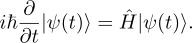
This evolution is linear and unitary. At this level, the theory is fully deterministic.
Physical quantities are represented by operators acting on the state, and measurement outcomes correspond to their eigenvalues.
We do not observe the wavefunction directly. Instead, we observe specific results—localized events in spacetime. The probabilities of these outcomes are given by the Born rule:

The terms in the wavefunction are complex-valued, and complex numbers cannot be interpreted as
probabilities in any meaningful way. The Born Rule acts as a translator that turns them into probabilities
by taking the absolute square  . The result is a positive, real number that specifies the probability of
finding the particle at a specific point in space and time.
. The result is a positive, real number that specifies the probability of
finding the particle at a specific point in space and time.
The double-slit experiment illustrates this. Even when particles are sent one at a time, an interference pattern emerges. The wavefunction propagates through both slits, while detection produces localized impacts.
This leads to a dual structure:
A quantum system can exist in a superposition of states:

This does not mean the system is partly in each state in a classical sense. Rather, the wavefunction encodes multiple possibilities simultaneously in a single mathematical object.
Crucially, amplitudes combine before probabilities are extracted:

This phase-sensitive structure enables interference.
To make this intuitive, consider a quantum coin. Unlike a real coin in our geometric space, a quantum coin exists as a superposition of states within a two-dimensional Hilbert space. It is described by a state vector:

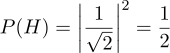
The coefficients α and β are probability amplitudes represented by complex numbers. These values are not probabilities themselves; rather, the probability of an outcome is determined by the absolute square (the Born Rule), requiring the state to be normalized:

For a fair coin where the outcomes are equiprobable, the amplitudes are defined as 1∕ (ignoring the
complex phase), since:
(ignoring the
complex phase), since:
In Hilbert space, exchanging two identical particles corresponds to a transformation of the state:
For fermions:

For bosons:

For fermions, this antisymmetry implies:

This is the Pauli exclusion principle: no two identical fermions can occupy the same quantum state.
For bosons, symmetric states allow multiple occupation. Any number of photons, for example, can occupy the same state. This enables phenomena such as Bose–Einstein condensation.
Particles do not possess classical individuality.
Consider a parabolic mirror. A photon emitted from the focal point is later detected on a screen after reflecting from the mirror. Classically, one would imagine the photon taking a specific path: leaving the source, reflecting at a definite point, and arriving at the detector.
However, the photon is not assigned a single trajectory. Instead, it can be shown that it takes all the possible paths. Contributions from the entire surface of the mirror determine where the particle most likely hits the screen.
Quantum systems can exhibit behavior that has no classical analogue. A particle encountering a potential barrier higher than its energy can still be detected on the other side.
This phenomenon, known as tunneling, does not imply that the particle travels through the barrier in the classical sense. The wavefunction simply has nonzero amplitude across the barrier, and measurement may yield a detection beyond it.
In this sense, it is not meaningful to ask how the particle “passed through” the barrier, or how long it spent inside it. The formalism provides probabilities of outcomes, not trajectories of individual objects.
This reinforces the idea that quantum particles are not persistent entities following well-defined paths, but manifestations of an underlying informational structure.
A plane wave:

has a well-defined momentum but is completely delocalized.
To localize a particle, one must superpose many momenta:
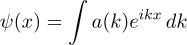
The more localized the position, the broader the momentum distribution. This is expressed by the uncertainty principle:
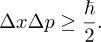
Heisenberg imagined trying to pinpoint the exact location of an electron by illuminating it with a photon. To see the electron more clearly, one needs a photon with a very short wavelength (high energy), like a gamma ray. However, a high-energy photon acts like a billiard ball; the moment it hits the electron to reveal its position, it delivers a massive kick of momentum, sending the electron flying off in an unpredictable direction. If one uses a lower-energy photon to avoid disturbing the electron, the long wavelength becomes too blurry to resolve the position. Heisenberg realized that the act of measurement itself imposes a fundamental limit: the more you sharpen your vision of where a particle is, the more you blur its path.
It would be easy to think that the uncertainty is just the problem of observation and that particles would actually have both well defined position and momentum, simultaneously. However, this is not the case.
Consider a single particle in a vast space. Its wavefunction is a pure sine wave. Its energy is
 where f is frequency. Its probability is perfectly flat. Because space is so huge, the
chance of finding the particle at any one specific point is practically zero. In this state, the
particle’s position is totally smeared out—it simply doesn’t have a specific ’here’ or ’there’. The
only way to localize the particle is to stack additional waves into the wavefunction. These
waves interfere with each other, canceling out in most places and peaking in one small spot.
But then you are mixing multiple energies together. The more you pin down the position,
the more the energy ’smears.’ The fuzziness isn’t a measurement error; it’s just how waves
work.
where f is frequency. Its probability is perfectly flat. Because space is so huge, the
chance of finding the particle at any one specific point is practically zero. In this state, the
particle’s position is totally smeared out—it simply doesn’t have a specific ’here’ or ’there’. The
only way to localize the particle is to stack additional waves into the wavefunction. These
waves interfere with each other, canceling out in most places and peaking in one small spot.
But then you are mixing multiple energies together. The more you pin down the position,
the more the energy ’smears.’ The fuzziness isn’t a measurement error; it’s just how waves
work.
It’s like a musical note: you can have a pure, steady pitch that lasts forever (perfect energy, no timing), or you can have a short, sharp ’staccato’ pop (perfect timing, no pitch). You physically cannot have both at once.
Composite systems can exhibit correlations that cannot be reduced to their parts. These correlations violate classical locality constraints, as demonstrated by Bell-type inequalities.
For example:
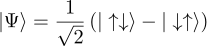
This state cannot be written as a product of individual states. The system must be described as a whole.
Entanglement is a defining feature of quantum mechanics, linking subsystems into a single, inseparable structure.
Composite systems can exhibit properties not present in their constituents.
An atom composed of an even number of fermions behaves as a boson, while one with an odd number behaves as a fermion. This affects how collections of such atoms behave statistically.
Bosonic atoms can occupy the same quantum state, leading to macroscopic quantum phenomena such as Bose–Einstein condensation.
This is a clear example of emergence: collective behavior obeys new rules not evident at the microscopic level.
When quantum mechanics is combined with special relativity, the natural framework becomes quantum field theory.
In QFT, fields—not particles—are fundamental. Every point in space is associated with field values. Particles appear as excitations of these fields.
A useful analogy is a continuous medium composed of coupled oscillators. Disturbances propagate as waves, and quantized excitations are observed as particles.
For a scalar field ϕ(x), the energy density may take the form:

Different fields correspond to different particles. Interactions arise from couplings between fields.
This framework is extraordinarily successful—provided spacetime itself remains fixed.
Quantum mechanics suffers the so-called measurement problem. QM describes a superposition of possibilities, yet observations yield definite outcomes. Particles are in all possible states, such as here and there - simulatenously, until observed.
What constitutes an “observer”?
Different interpretations offer different answers:
The formalism itself does not uniquely define what an observer is.
A modern operational view is that an observer is any system that produces a stable record of information through interaction.
(TODO: Need to hypothetize whether my wife meets the criteria of being a stable records of information. That is a brave hypothesis to test! Proceed with extreme caution—that particular variable has a reputation for being highly volatile, regardless of what the laws of physics might suggest!)
When a system interacts with an environment, entanglement spreads information across many degrees of freedom.
At the level of the full system, evolution remains unitary. However, when one considers only a subsystem, information appears to be lost.
This is captured by the reduced density matrix:

Interactions with the environment suppress interference terms—a process known as decoherence.
Entropy of the subsystem increases:

Information becomes distributed into many inaccessible degrees of freedom. Reversing this process would require control over an enormous number of variables.
Thus, irreversibility emerges not as a fundamental law, but as a practical consequence of complexity.
An “observer,” in this sense, is a system that participates in such irreversible encoding of information.
What is the system we have described here?